IF YOU LOVE ME, HOLD ME

Hold me,
not just my hand,
but all of me.
Wrap your arms around my body
like you know what it’s been through.
Like you’ve heard the storms it carries
and still want to dance in the rain with me.

Take my hand,
don’t ask where we’re going.
Let’s run,
not to escape,
but to feel free
for the first time in a long time.

Hold my heart,
gently,
like it’s the last soft thing in a hard world.
Place it close to yours,
let them beat together
in a rhythm only we understand.

Touch my waist like it’s sacred.
Pull me into your chest
like you’re pulling me into forever.
And when you kiss me,
don’t make it rushed.
Kiss me like you’re trying to teach time
how to slow down.

If one tear falls—just one,
don’t panic.
Wipe it.
Don’t ask if I’m okay,
just look at me like you see everything
and say,
“It’s going to be alright.”
And mean it.

When I say I’m cold,
don’t go looking for a sweater.
Be the warmth.
Be the safe place I curl into
when the night gets too loud.

And when I say “I love you,”
don’t whisper it back.
Say it like a vow.
Say it like your soul recognizes mine.
Say it like you’re not going anywhere.

Because real love
isn’t made of grand gestures.
It’s in how you stay,
how you see me,
how you reach for me in silence.

So if you love me,
hold me,
not just in your arms,
but in your everyday.

@Okelododdychitchats

Crunchy Honest Chips

I was born just outside my father’s home. I mean outside the fence. Not in a hospital. Not in some sterile maternity ward with nurses who smell like Dettol and sigh through masks. No. I came into this world the traditional way, on ancestral soil, barefoot and bold, like a true son of Asembo. My grandmother delivered me. I’ve said this before, and I’ll say it until my tongue is weary, it’s something to be proud of. It’s raw. It’s traditional. And I guess, so am I.

Asembo is about 15 minutes away from Raila’s Opoda Farm. But this is not about him. This is about home. Or the idea of it. Because although I was born there, I didn’t grow up there. In fact, it took me seventeen years to return. And when I finally did, with the awkward gait of a visitor in his own past, I found our home was no longer a home. It had become a farm.

The only proof we were ever there are the graves—traces of my father, my uncle, my grandmother, and my grandfather. The cement doesn’t crack. It holds secrets. They told me the land is mine now. Or at least part of it. My father was the last born, and in our traditions, that means the home was his. By extension, now mine. But what do you do with a piece of land full of ghosts?

There’s another parcel—12 acres or so. I didn’t earn it. Didn’t break my back for it. Didn’t argue with chiefs or attend land tribunal hearings in stuffy rooms with men who say “utu ni utu” before betraying you for a bribe. It was passed to me like a baton in a relay. A gift from the dead. So no, I’m not bragging. And even if I was, who really wants to sweat for something they can get for free? This is Kenya, after all. We queue for handouts and call it luck.

I grew up in bits and pieces—Homa Bay, Kisumu, Rongo. Like a nomad in search of permanence. In 2007, my mother built a modest house in Rongo. That’s home now. We live there with strangers who’ve since become family, the kind you don’t choose but grow into like an oversized sweater that slowly starts to fit. In Rongo and almost everywhere else in Luo Nyanza, people intermarry—Luos, Luhyas, Kisiis. But not Kikuyus. No, Kikuyus are where the line is drawn.

Luos hate Kikuyus and Kikuyus hate Luos. That’s the story we were handed by the colonialists—wrapped in propaganda and sprinkled with enough suspicion to last generations. Divide and rule. And rule they did. Now we inherit the hate like old family furniture we’re too proud to throw out. We say things like: “A Luo is a witch with a sack of rituals on his back” or “A Kikuyu is greedy and selfish” or that “Kikuyu women kill their husbands.” What is that? That’s not wisdom. That’s premium-grade poetic cow dung.

Ask anyone for proof, and they’ll stutter like a bad radio signal.

I don’t believe in what I haven’t seen. I won’t condemn a whole tribe because Otieno once borrowed your charger and never returned it. Or because Wanjiku blocked you on WhatsApp after you bought her chips kuku.

If that makes me fallacious, then call me a walking fallacy.

And listen, Kikuyu women are beautiful. Not the stereotypical light-skinned, big-chested, flat-behind and thin legs that don’t  match the body types, those that your uncles warned you about. No. These days, they come in thick—size sevens with curves that look like they were negotiated in parliament. Faces sculpted like the gods used cheekbones as currency. And thighs, God help us, thighs the colour of roasted cashews—thighs that can save entire nations.

I’m dating one. A Kikuyu. Six years now, give or take a few breaks that almost broke us. Her name is Koi, but if you know her like I do, you call her Spiky. And Spiky? Spiky is divine.

Spiky is what you’d get if elegance had a baby with audacity. She walks like confidence and still laughs like she was raised by love. Her skin is caramel dipped in honey, the kind that makes you wonder if sunlight took lessons from her. Her smile is a gospel that can turn a hard man soft. She’s smart, too. Smart with the kind of intelligence that knows when to speak, when to keep quiet, and when to look at you in a way that makes you question all your life choices.

Her body is poetry. The kind of body that makes you want to write odes in traffic. Her mind is a map. Her heart is a home I keep returning to. Even when I say I’m done.

I am not here to convert you. I am just here to say—love is not tribal. Neither is beauty. Neither is home.

Some of us were just born outside, by grandmothers with hands strong enough to deliver a future.

And maybe that’s enough.

It was 2AM or thereabouts. You know that hour that’s neither here nor there—when the silence feels staged, like the night is watching you back. I wasn’t asleep, of course. My insomnia is back. It always returns like an old lover who doesn’t knock, just walks in and makes itself comfortable.

Spiky was up too, prepping for one of her strange shifts. She works those ungodly hours, where your body wants to rest, but capitalism wants a report submitted by 5:45AM. I decided to keep her company, texting back and forth. In the middle of our banter—whose contents I won’t get into, partly because I’m lazy and partly because it might send you off on a tangent—we veered into a detour.

There’s a Mugithi na Ndumo at Red Room from 2PM,” she texted. “Come with me?”

Mugithi is a Kikuyu genre—think of it as country music that drank a full bottle of Muratina and decided to wear a hat. Ndumo is the dance—the erratic, shoulder-driven, hip-twisting rhythmic warfare. It’s like watching a fight that no one wants to break up. I don’t speak Kikuyu. I know only “mbesha shigana?” which loosely translates to “how much money are we wasting here?” But I said yes. Because love is also showing up where you don’t belong and hoping the rhythm saves you.

Google Maps says Red Room is in Kilimani. Technically true. It’s on Adlife Plaza. But if you follow those blue dots on Google blindly, you’ll find yourself in West Pokot or emotionally lost. Take my advice: get to Yaya Centre, take that left turn. Adlife Plaza is a few blocks in, across from Shujah Mall. Red Room lives on the first floor.

The place is cool.  Genuinely cool. It’s shaped like an L, as if someone folded the club and forgot to unfold it. The counter sits at the center like a bartender god. There’s a stage—clean, slightly elevated, and a DJ booth carved with intention, not just dumped there. The seats in the regular area are metallic, but not the koroga kind. These ones have cushions that hold your secrets. They are comfortable. The VIP area, of course, has better seats—those white kinyozi-waiting-area chairs, only here they’ve been baptized and saved.

The roof is translucent, high enough not to threaten your dignity, and there’s space to dance without knocking a stranger’s elbow. The floor is plastic turf. That fake grass that doesn’t pretend to be real anymore. The kind you’d find in a cool rooftop bar, or a child’s playground where no one gets hurt when they fall—except emotionally.

Our waiter is polite. Genuine. The kind that makes you want to tip even when you’re broke. We order goat meat and chips not fries. I refuse to gentrify potatoes. Spiky, glowing like the first sip of good wine, is in wide-legged purple pants stitched by a fundi who understands women. Her top—a crocheted piece of African fabric art—is from the same fundi. She looks like Nairobi confidence dressed in culture. I’m in wide-legged pants too (no judgment), a free shirt I got from Dura Poa and my trusted white Converse. I order a litre of Muratina because, well, when in Rome… get tipsy on their traditions.

Spiky orders two bottles of Kenya Originals.

The food comes and we eat because what else do you do when food comes? Their meat is soft. Tender like it was raised by a grandmother with a kind voice. The chips are golden and crunchy—honest chips, not those oily, sad ones that taste like heartbreak.

Then comes Gasheni. She wasn’t on the lineup, just a curtain raiser. But sometimes curtain raisers leave you wondering why the main act even bothered. She did well. She cleared the path like John the Baptist. And when DJ Dibull came on, he walked through like the Messiah of sound. He played magic. I danced. I didn’t understand a single lyric but my body understood the beat, and sometimes, that’s all that matters.

Tony Young came in next. One hour and thirty minutes of pure Kikuyu Vaibu. By the time Waithaka Wa Jane got on stage, I think the crowd was tired. Or maybe he was just too mellow for 11PM energy.

Ah, I almost forgot—DJ 44. That man spins like he’s in love with every beat. Like each song owes him rent.

At our table, a couple and a lady joined us. Later, a guy.   All of them were vibes. They figured out pretty quickly that I wasn’t Kikuyu—maybe it was the way I danced, like someone dodging potholes. But they embraced me. One of them told me, “If you can’t beat us, join us.”

So I did.

And I’ve invited them to the Luo Festival on the 9th of August. There, I’ll beat them. And they’ll join me. And we’ll call it unity.

Mugithi was greatness. Pure, fermented, cultural greatness. The kind that reminds you that sometimes all it takes is a beat for you to remember how good it feels to just live.

Thank you for this Spiky. I loved it Baby!

@okelododdychitchats

To You, Tonight

You say you don’t read much.
But somehow, you always read me.
And maybe, without knowing,
You taught me how to bleed through the pen,
To shape silence into syllables,
To hold space for feeling,
Even when the world is loud.

So tonight,
As night settles in a robe of velvet quiet,
I write not to ask, nor to explain,
But to bless you, softly.

When the night folds her arms around the sky,
And the stars murmur lullabies in silver tongues,
May your burdens loosen,
May your spirit stretch.

For even the moon, full in her glow,
Knows the ache of holding light too long.

Rest, love.
Lay down the weight of unspoken things.
Let dreams drift in like gentle winds
Through the windows of your mind.

Don’t dwell,
Not on what didn’t grow,
Not on what wasn’t said.

Just sleep.
And let this be the lull in the poem of your life,
The stanza where you exhale.

Goodnight, beloved.
Goodnight.

@okelododdychitchats

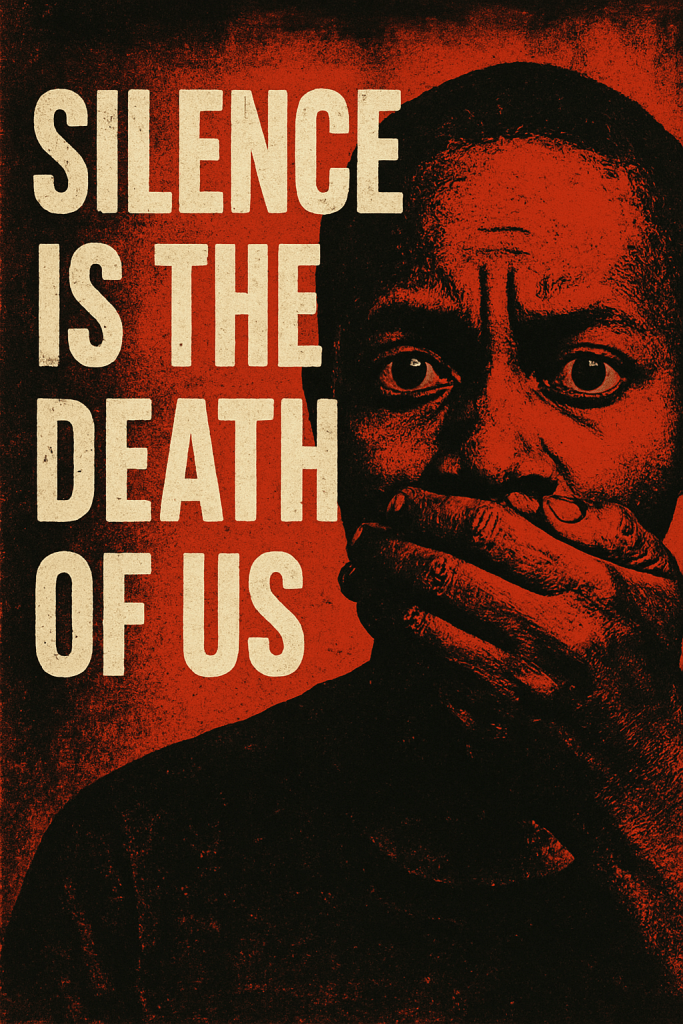
SILENCE IS THE DEATH OF US

Dear Corporate,

I know you like your linen white.
White as milk.
With no stains, no creases,
And no voices too loud or opinions too strong.
You want clean reputations,
Clean photos, clean silence.

You like me better
When I just show up, smile, hit targets,
Say “yes sir” to everything and go home.
You like me better
When I keep the fire in my belly out of your boardroom.
When I don’t question, when I don’t care too much.

But here’s what you forget,

I was me before I became your employee.
I had a voice before I had your email signature.
I had convictions before I had a clock-in code.
And I’m not about to trade all that in
For job security and polite applause.

I love justice.
The same way you love KPIs.
I care about this country,
The same way you care about brand image.

So when you see me at a protest,
Don’t flinch.
I’m not unstable.
I’m not rebellious.
I’m just awake.

When I call out corruption,
I’m not ruining your name,
I’m protecting it.
Because if systems rot,
Your success does too.

When I tweet in anger,
It’s not because I’m angry all the time.
It’s because I still believe that things can change.
That voices matter. That silence is too heavy to carry anymore.

I’m not asking for much.

Just this,
Don’t punish me for caring.
Don’t blacklist me for believing.
Don’t put me in a corner
Because I refuse to play blind.

I want to work.
I want to grow.
But I also want to live in a country where truth doesn’t cost you your job.

Let me speak.
Let me stand.
Let me protest, cry out, and still walk into your office on Monday morning with purpose.
Because fighting for what’s right
And showing up for work
Aren’t enemies.
They’re both signs I give a DAMN.

So no,
I’m not mad.
I’m not disloyal.
I’m just patriotic.
And I won’t whisper that.

Sincerely,
Still the right person for the job. Just louder.

@okelododdychitchats

Silenceisthedeathofus #Speak #PoeticJustice #Justice #Justice4AlbertOjwang #SpeakUp #Corruption #EndCorruption

When I fall in Love


When I fall in love,
there will be no trumpet,
no choir of angels rehearsing hallelujah,
just the quiet breaking of bread
between two hands that have known hunger.

I will not ask the sun to shine,
it will.
I will not beg the wind to be still
it will not.
But you,
you will laugh like sugar spilling from a jar
and I will remember
how joy can be messy
and still be beautiful.

When I fall in love,
I will not be the half of a whole,
I will be
the whole of a whole
meeting another
who does not need
completing,
only witnessing.

There will be no ticking clock,
no red thread prophecy,
no trembling knees
(unless from laughter).
I will not call it fate.
I will call it choice.
I will choose you.
And choose you again.
Even when your smile falters,
even when your breath
carries thunder.

I will not write sonnets.
I will write grocery lists
with your name at the bottom
underlined twice.
We will argue about soup.
And make up in whispers
like old songs
that only the two of us remember.

When I fall in love,
I will not promise forever.
But I will give you every now
I can carry.
I will plant soft yeses
in the soil of every day.
I will hold space
for your shadow
and your shine.

And when I say goodbye,
(if goodbye must come)
it will be with the ache
of one who has lived
and not regretted
a single soft, unspoken
I love you.

When I fall in love,
it will not be a fairy tale.
It will be
a revolution
of two
sacred, flawed,
magnificent
souls
saying,
yes, still.

And you,
you will not be worshipped.
You will be
seen.
And that, my love,
is holy enough.

@okelododdychitchats

It’s Colonial, I Swear

What happened before the roses came ?

1. Cold Showers and Pink Suits

There’s a special place in hell for cold showers and it’s probably somewhere next to the queue at the passport office. And now you want me to willfully take one, shave, powder my neck, and wear that pink suit that makes me look like a soft loan? Just to go out on a date? Bruh. That’s not love; that’s martyrdom. I did not survive Nairobi water bills to be out here moisturizing for cold balconies and cappuccino dust.

2. Love in the Time of Third Parties

Who even decided that love needs to come with an invoice and VAT? Dating in this economy feels like trying to start a business on a chama budget. You spend thousands to sit across someone in a place where both of you are silently trying to gauge who is more emotionally unavailable, while the waitress thinks you’re about to propose.

3. The Whitewashing of Romance

Let’s talk about it: is the modern date a colonial export? Imported like jazz music and instant noodles? Because, really, how did our grandfathers do it? They didn’t need a date. They needed a strong back, a hoe, and a keen eye for dowry negotiation. Now we’re out here buying roses that die in 48 hours, basically love-shaped perishables and calling it romance.

4. Introverts Anonymous

I’m not antisocial. I’m pro-solitude. There’s a difference. Why must love always be on display, like it’s a talent show and we’re all auditioning for the role of “Emotionally Available Partner ”? Me, I prefer my affection with a side of silence. Just Netflix algorithms that understand me better than most people.

5. The Psychology of Smashing vs Smiling

Some dates feel more like interrogations with ambience. You’re sitting there, trying to chew tasteless pasta gracefully while wondering if she thinks your smile means “I like you” or “I’m just horny.” You’re sweating from trying to remember if you mentioned you were raised Christian or spiritual but not religious.

6. Date Inflation & Emotional Capitalism

Who decided that love must be shown through receipts? That emotional availability must be measured by how many brunches you’ve paid for? I’ve dated women who thought the absence of fine dining was the absence of love. Hey, the pepper in my githeri is a form of affection. Don’t let capitalism gaslight your heart.

7. Domestic Love, Anyone?

Let’s stay home. I can cook, I can serve, and I can even throw in bad jokes for seasoning. No need for that performative laughter at Java. I want us barefoot in the house, arguing about how much salt I put in the food. That, my friends, is real bonding. And I can pause to pee during the movie without missing the plot or the bill.

8. Public Displays of Affection Fatigue

What’s so romantic about someone interrupting your moment to ask “would you like sparkling or still?” Let me love you in sweatpants. Let’s laugh over burnt ugali. Let’s fall asleep on opposite ends of the couch and meet halfway in a dream. That’s the kind of love that doesn’t make it to Instagram, but lasts.

9. Love Without Logistics

The planning of dates stresses me more than the dating itself. Reservations, rides, fitting into attires from 2021, it’s a full-time job. Why can’t we date like we used to play kalongo in childhood? Spontaneous, anarchic, and mostly in someone’s house with limited adult supervision.

10. Let’s Redefine Romance

So no, I’m not taking cold showers for a warm table. That doesn’t mean I love less. I just love differently. Quietly. Deeply. With less garnish and more substance. If love is a language, I speak it fluently in slippers and home-cooked meals. The balcony is cold, the city is expensive, and my pink suit is for weddings only. Choose your battles wisely. Choose your love even wiser.

@okelododdychitchats

We are no longer Babies

It’s 1:58 AM, and Azel is crying. Blood is oozing from my nose, it’s a lot. We’re in the middle of wheat bushes and dry, soft sand along the Bomet-Narok road. Azel has never seen this much blood come from someone’s nose before. A neighbour from the seat beside us heads up to the driver and asks him to help somehow, and he honors the call. A group of ladies and gentlemen from the bus volunteer to offer first aid. I don’t know any of them, except for my five-year-old nephew. But for what you’ve all done, thank you, I truly appreciate each of you and I love you all.

Azel has stopped crying now, though he still looks worried. We’re on our way to Nairobi, and I’m anxious about the second half of this journey. We’re traveling at night ! Kumbavu zangu, mbwa mimi, what was I thinking? I made a mistake.

I had been in the village for Azel. I love this kid, people think he is a rock of my sling. He was graduating from PP2 to Grade One on October 22nd, two months after his birthday. The number 22 seems to be a blessing for him, so I’ll get him a Gor Mahia jersey with that number on the back. I would’ve initiated him into Manchester United fandom, but I don’t want him stressing over his blood pressure every game!

We’re moving down the hill toward the isolated polytechnic outside Narok Town, near Ntulele, where there’s little but a footbridge, well-made tarmac, and an animal crossing. The place is rich with all kinds of trees, baboons, monkeys, and possibly other wild animals hidden in the bushes. At this hour, it even smells of charcoal. Are they teaching students to make charcoal at night? There are no homes here, just bushes. Multimedia University has got nothing on this polytechnic for natural surroundings!

Wait, I was telling you about Azel’s graduation… He got to school early for practice, and we followed a bit later. I can see him in the crowd, my young, handsome guy with his friend, he is scanning around to find us. He looks tired and weak, probably still worn out from that malaria he’s been fighting. All I want in that moment is to knock that malaria out myself. When he loses hope and starts heading back to the training area, I quickly send a friend to bring him over to where we’re sitting, me, Mum, and my “sisters,” Millie and Mercy.

When he gets to us, I can tell he’s hungry just by the look on his face, so I hand him his favourite combo, tomato crisps and vanilla yogurt. But he gives me a polite, “No, thank you,” which hits me right in the heart. I ask him what he actually wants as he tugs on my arm, pulling me up. Turns out he needs money for his graduation badge, so I cover it and get him some ice cream too, he’d asked for it.

Parents watch the “Holistic Space Academy” pupils perform. “Holistic Space” is Azel’s school, and these kids are talented! The music club is fantastic, truly entertaining… Soon, Azel’s class, PP2, is welcomed by the music band, led by their teacher, Teacher Rose, who organizes them into two neat lines, girls in front, boys at the back, all by height. Brave little souls, each of them, dressed in black and yellow gowns with badges neatly fastened on the left. They perform songs and poems, with one that stands out, “We Are No Longer Babies.”  They say goodbye to kindergarten. The school really lives up to its name, they’ve created such a well-rounded environment here. The event is beautiful. Azel is back to his happy, playful self, he gets his certificate, they cut the cake, and then we head home.

Everything’s good at home, Azel’s happy, schools are closed, and he’s officially no longer a baby. Next year, he’ll be in Grade One, and he’ll be traveling to Nairobi soon!

Finally, it’s the big day. Azel’s up just after 5 AM, barely slept, ready to go, even though we’re technically not leaving until 8:45. You’ll understand why I say technically.I get up around 7, and I can already hear him by the front door, singing, “Ninaenda Nairobi.” It’s the little things that make kids happy. We finish preparing, and before we leave, Mum gathers us for a prayer, she prays for the things made with the hand of man to allow us arrive safe. After that moment, we say our goodbyes and leave for the booking office.

But when we arrive, I realize I’ve booked us on the night bus instead of the morning one. Frustration bubbles up, especially with Azel along for the ride, so I call my mum and my sister Stella, Azel’s mum. They both seem okay with us traveling at night, which eases my mind. I call my Okada man, Babgy, and we head back home to wait for the night.

At this point, Azel can’t afford to lose sight of me, he thinks I might pull a fast one and leave him in the village. What keeps his hopes high is the fact that we left his bag at the booking office. My little guy, who’s no longer a baby, is happy, and when he’s in a good mood, he praises everyone around him. He calls me “Ado,” calls Millie “Amillo,” and the best moment comes when he sees our neighbor Ada. He moves closer to her, saying, “Eiii Ada, Jaberrrr,” in his best Luo accent. Hearing this from a kid is just wonderfully fantastic.

The time comes to say goodbye and Azel’s dream of travelling to Nairobi is finally a reality!

@okelododdychitchats