The Opportunity Cost of a Lost Girl: Why Adolescent Health Is an Economic Issue

To address the structural challenges of adolescent health in Kenya, experts are increasingly viewing the Triple Threat, the intersection of teenage pregnancy, HIV, and gender-based violence, as a singular public health emergency that requires a unified institutional response. The gradual erosion of national pregnancy rates, which dropped from 18% to 15%, is seen by policy analysts as a sign of progress, yet one that masks deep-seated regional inequalities. In areas like Samburu, where the rate remains at 50%, the crisis is viewed not merely as a health issue, but as a systemic breakdown of the protective social infrastructure intended to support the girl child. This crisis is compounded by the Triple Threat synergy,  a lack of agency to negotiate safe sex often results in a simultaneous surge in new HIV infections and unplanned pregnancies, frequently rooted in gender-based violence.

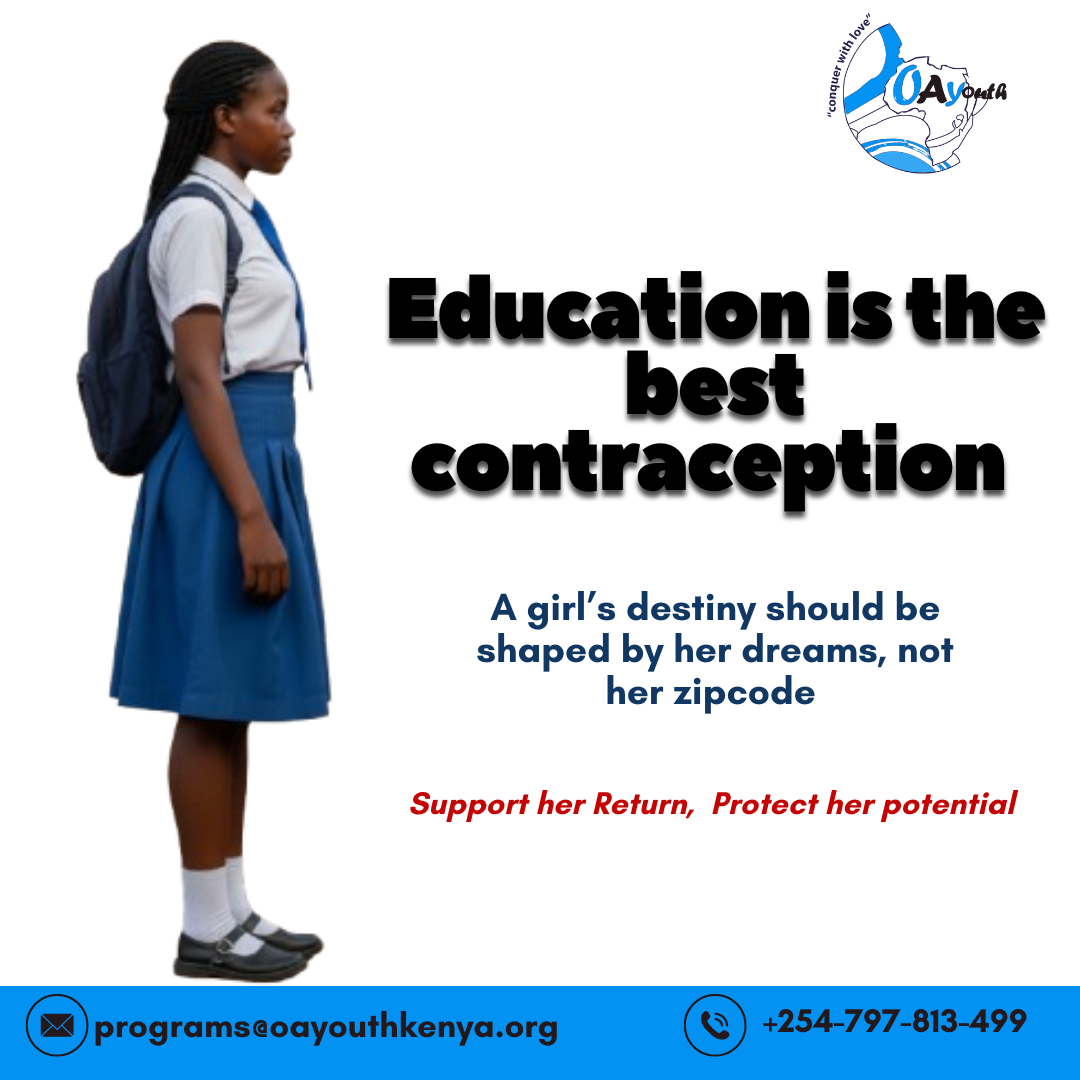
Education remains the most significant predictor of reproductive outcomes in the country. Data from the Kenya National Bureau of Statistics (KNBS, 2022) indicates that only 5% of girls who complete secondary school become pregnant, a stark contrast to the 40% observed among those with no formal education. Institutional experts emphasize that education is thebest contraceptive, serving as the most effective long-term shield for a girl’s future. The current Education Re-entry Policy is designed to treat pregnancy as a temporary pause in a girl’s development rather than a permanent exit from society. By mandating that schools readmit young mothers without conditions, the government is prioritizing the long-term economic viability of these young women. We must support her return and protect her potential to mitigate the massive opportunity cost to the national GDP.

With the rollout of the Social Health Authority (SHA), there is a strategic move to eliminate the financial barriers that often drive transactional sex. This phenomenon occurs when girls, particularly from the poorest households, exchange sexual favours for basic necessities like sanitary pads or school fees. Health administrators argue that removing the cost of maternal care is a pivotal step in normalizing adolescent health services. When girls can access youth-friendly clinics without the fear of financial strain or the stigma of judgment, the likelihood of safe deliveries and the adoption of postpartum family planning increases. This approach frames reproductive care as an essential public service, similar to the management of other chronic health conditions.

Sociological research highlights that the social death of a pregnant teenager is frequently a by-product of community-level shaming. While childbearing rates are significantly higher in the lowest income bracket, they drop drastically for the wealthiest, suggesting that pregnancy is often a symptom of economic desperation. The community’s role must shift from isolation to integration, especially as new threats like digital grooming emerge. Experts suggest that a girl’s destiny should be shaped by her dreams, not her zip code, and that ending thesocial death of teenage pregnancy is Kenya’s path to a stronger nation. Breaking the cycle of poverty requires community leaders to stop negotiating defilement cases through traditional settlements and instead move toward formal legal accountability.

For Kenya to reach its development goals, the focus must remain on the enforcement of the Sexual Offences Act at the grassroots level. Legal advocates insist that justice cannot be settled with livestock or secret payments. Every instance of legal accountability sends a clear signal that the safety and education of the girl child are non-negotiable national priorities. By aligning government policy, community action, and economic support, the goal is to ensure that every girl has the power to decide her own future on her own terms.

@doddyokelo

What Next for Kenya’s HIV Response?

Otieno, a resident of Kamwango in East Kamagambo, Rongo Sub-county, sits on the edge of his bed, the weight of the world pressing heavily upon his shoulders. He looks at his wife, Achieng, who is meticulously organizing their remaining ARV tablets, and their seven-year-old daughter playing by the window. For years, those pills have been their lifeline, a daily ritual of survival. But the news on the radio is cold. Following the transition in Washington on January 20th, 2025, and the looming impact of March 2026, the whispers in the clinic queues have turned into a dull roar of panic. He hears that the containers might stop coming, and the thought of the virus waking up in his daughter’s blood because of a political shift thousands of miles away is a terror no father should carry.

For 23 years, Kenya has been receiving roughly 69% of its HIV funding from the United States Agency for International Development (USAID) and the United States President’s Emergency Plan for AIDS Relief (PEPFAR). This massive investment, totaling over 8 billion dollars (approximately 1.1 trillion Kenyan shillings) was the backbone of the national response, paying for the very ARVs Otieno’s family is counting on, the laboratory reagents for viral load testing, and the salaries of over 40,000 health workers, nearly 18% of the country’s total health workforce, who now face an uncertain future.

The crisis has ceased to be a storm on the horizon, it has become the drying of the well, a sudden, natural silence where the ever-flowing vein of supply once lived long. Since the executive freeze in early 2025, approximately 34 million dollars (4.5 billion Kenyan shillings) worth of life-saving commodities have been caught in a logistical gridlock. This disruption was triggered by a stop-work order that deactivated the payment and distribution systems managed by U.S.-funded agencies. By March 2026, the buffer stocks that once protected patients like Otieno from supply shocks will have run dry. In many facilities, doctors have been forced to ration medicine, moving from three-month prescriptions to one-week emergency packs, a desperate measure to ensure that at least everyone gets something, even if it isn’t enough.

To bridge this gap and heal the mess of daily adherence, there is a growing call to develop and deploy long-acting treatments for reactive individuals. While currently available injections like Cabenuva require a visit every two months, the dream is to innovate even further, creating a once or twice yearly injection specifically for treatment. Such a breakthrough would be the ultimate sustainability tool by replacing 365 daily reminders with just one or two clinical visits, the government could drastically reduce the logistical nightmare of monthly pill distribution. It would solve the adherence crisis for families like Otieno’s, ensuring that even if a shipment is delayed or a clinic is crowded, their protection remains locked in their blood for months. This transition to long-acting treatment is the missing piece that could turn the tide, making the 2030 goal of zero transmission a reality by removing human error and pill fatigue from the equation.

The physical landscape of care is also shrinking. Community Drop-In Centers, which provided a refuge for vulnerable groups to receive medication away from the prying eyes of the general public, have begun to shut their doors as their rent and staff costs were tied directly to the now-paused U.S. grants. This has pushed thousands of patients back into overcrowded outpatient clinics where stigma remains a biting reality. The shift is driven by a fundamental pivot in U.S. foreign policy toward domestic rescissions, clawing back billions in global health aid and leaving a Sh30 billion hole in Kenya’s 2026 health budget.

The Kenyan government has responded with urgency and strategic redesign. Health officials, led by the Ministry of Health, are frantically working to integrate HIV services into the new Social Health Authority (SHA). The goal is to move HIV care from a donor-funded silo into the national insurance framework, essentially treating it like any other chronic condition. To prevent a total stockout, the government is also fast-tracking licenses for local pharmaceutical companies to manufacture ARVs within Kenya, aiming to break the cycle of dependency on foreign shipments that can be halted by a single signature in a foreign capital.

Sustainability is the ultimate goal, but it is a bridge built under fire. The National Treasury is being asked to ring-fence emergency funds to unlock meds held in private warehouses, while civil society groups under the National Empowerment Network of People living with HIV in Kenya (NEPHAK) have taken to the streets to demand that laboratory tests, like viral loads and CD4 counts, remain free under the new insurance scheme. While the move toward a Kenyan-led, self-reliant system is the only long-term solution, for Otieno’s family, the immediate reality is a month-by-month struggle to stay undetectable while the country waits for the first gears of its own factories to turn with purpose.

@doddyokelo

AND YET, WE VOTE

WHO PROTECTS THE PEOPLE FROM THE POLICE ?


You may write us off,
dismiss us ,
ignore us in Parliament halls padded with stolen wealth,
but still, we see

We are the country beneath your motorcades,
the hands that build and break,
the voices cracking in the dust
because hope costs too much now.

And yet,
we vote.

We vote for thieves in clean suits

We vote for wolves draped in our flags,

Enough.

We are tired.
Tired of job descriptions reading “Must be connected.”
Tired of degrees gathering dust
while our dreams starve in silence.

We are tired of joblessness turned into weaponry,
young men hired cheap to kill our own voices,
paid to break bones they’ve never healed in their own lives.

Tired of watching peaceful protesters
shot dead,
while those who loot in daylight
are guarded like royalty.

Tired of asking:
“Who protects the people from the police?”

Tired of staged outrage,
press conferences filled with air,
and politicians who only remember their roots
when it’s time to lie again.

You fight for positions, not for people.
You dine with the devil,
then kneel in churches too small for your sins.

You debate your egos on live TV
as our people dig trenches
not for roads,
but for graves.

You die to be seen.
But we die because we’re ignored.

Kenya is choking.
On debt.
On lies.
On the stink of promises unkept.

We are not asking.
We are telling.

This time, we vote with memory.
With pain.
With names.
With tears that learned how to speak.

This time,
you will not scare us with teargas.
You will not buy us with t-shirts.
You will not distract us with empty tribal drums.

We will remember who was silent when we bled.
We will remember who smiled while we starved.
We will remember who disappeared our brothers
and called us TREASONOUS CRIMINALS.

We are not the children you once fooled.
We have grown teeth.
We have grown rage.
And we are coming.

So let the ballot tremble.
Let your seats shake.
Let the ground beneath your stolen homes shift.

Because next time,
we are not just voting.

We are reclaiming.

And if you still don’t listen,
then hear this:

We are not afraid.
We are not asleep.
We are not yours.
Not anymore.

@Okelododdychitchats


#RUTOMUSTGO #ENDPOLICEBRUTALITY #RAGEANDCOURAGE
#JUSTICEFORELIJOSHUA

SILENCE IS THE DEATH OF US

Dear Corporate,

I know you like your linen white.
White as milk.
With no stains, no creases,
And no voices too loud or opinions too strong.
You want clean reputations,
Clean photos, clean silence.

You like me better
When I just show up, smile, hit targets,
Say “yes sir” to everything and go home.
You like me better
When I keep the fire in my belly out of your boardroom.
When I don’t question, when I don’t care too much.

But here’s what you forget,

I was me before I became your employee.
I had a voice before I had your email signature.
I had convictions before I had a clock-in code.
And I’m not about to trade all that in
For job security and polite applause.

I love justice.
The same way you love KPIs.
I care about this country,
The same way you care about brand image.

So when you see me at a protest,
Don’t flinch.
I’m not unstable.
I’m not rebellious.
I’m just awake.

When I call out corruption,
I’m not ruining your name,
I’m protecting it.
Because if systems rot,
Your success does too.

When I tweet in anger,
It’s not because I’m angry all the time.
It’s because I still believe that things can change.
That voices matter. That silence is too heavy to carry anymore.

I’m not asking for much.

Just this,
Don’t punish me for caring.
Don’t blacklist me for believing.
Don’t put me in a corner
Because I refuse to play blind.

I want to work.
I want to grow.
But I also want to live in a country where truth doesn’t cost you your job.

Let me speak.
Let me stand.
Let me protest, cry out, and still walk into your office on Monday morning with purpose.
Because fighting for what’s right
And showing up for work
Aren’t enemies.
They’re both signs I give a DAMN.

So no,
I’m not mad.
I’m not disloyal.
I’m just patriotic.
And I won’t whisper that.

Sincerely,
Still the right person for the job. Just louder.

@okelododdychitchats

Silenceisthedeathofus #Speak #PoeticJustice #Justice #Justice4AlbertOjwang #SpeakUp #Corruption #EndCorruption

Everything Here Smells of You


Everything here smells of you.
And it’s driving me insane in the sweetest, slowest way.

The caution seat still wears your scent ,
like it misses you too,
like it knows something passed through it that doesn’t come around often.

The fleece blanket is basically you in thread and warmth.
I cover myself with it and swear I can hear your laugh if I’m quiet enough.

Even my chest,
my own damn skin,
smells like you stayed.
Like you pressed yourself into me and said, “Don’t forget.”

And I won’t.
Not with lips like yours, warm, like you know the secret to sunrise.
I imagine a kiss and it doesn’t even feel imaginary,
it feels like a memory I’m about to make again.

I love the way your waist fits in my hands,
like my fingers were carved with your shape in mind.
There’s something wild about that kind of symmetry.

You’re beautiful.
You’re art that didn’t ask to be admired,
but was anyway,
because how could the world not notice you?

@okelododdychitchats

It’s Colonial, I Swear

What happened before the roses came ?

1. Cold Showers and Pink Suits

There’s a special place in hell for cold showers and it’s probably somewhere next to the queue at the passport office. And now you want me to willfully take one, shave, powder my neck, and wear that pink suit that makes me look like a soft loan? Just to go out on a date? Bruh. That’s not love; that’s martyrdom. I did not survive Nairobi water bills to be out here moisturizing for cold balconies and cappuccino dust.

2. Love in the Time of Third Parties

Who even decided that love needs to come with an invoice and VAT? Dating in this economy feels like trying to start a business on a chama budget. You spend thousands to sit across someone in a place where both of you are silently trying to gauge who is more emotionally unavailable, while the waitress thinks you’re about to propose.

3. The Whitewashing of Romance

Let’s talk about it: is the modern date a colonial export? Imported like jazz music and instant noodles? Because, really, how did our grandfathers do it? They didn’t need a date. They needed a strong back, a hoe, and a keen eye for dowry negotiation. Now we’re out here buying roses that die in 48 hours, basically love-shaped perishables and calling it romance.

4. Introverts Anonymous

I’m not antisocial. I’m pro-solitude. There’s a difference. Why must love always be on display, like it’s a talent show and we’re all auditioning for the role of “Emotionally Available Partner ”? Me, I prefer my affection with a side of silence. Just Netflix algorithms that understand me better than most people.

5. The Psychology of Smashing vs Smiling

Some dates feel more like interrogations with ambience. You’re sitting there, trying to chew tasteless pasta gracefully while wondering if she thinks your smile means “I like you” or “I’m just horny.” You’re sweating from trying to remember if you mentioned you were raised Christian or spiritual but not religious.

6. Date Inflation & Emotional Capitalism

Who decided that love must be shown through receipts? That emotional availability must be measured by how many brunches you’ve paid for? I’ve dated women who thought the absence of fine dining was the absence of love. Hey, the pepper in my githeri is a form of affection. Don’t let capitalism gaslight your heart.

7. Domestic Love, Anyone?

Let’s stay home. I can cook, I can serve, and I can even throw in bad jokes for seasoning. No need for that performative laughter at Java. I want us barefoot in the house, arguing about how much salt I put in the food. That, my friends, is real bonding. And I can pause to pee during the movie without missing the plot or the bill.

8. Public Displays of Affection Fatigue

What’s so romantic about someone interrupting your moment to ask “would you like sparkling or still?” Let me love you in sweatpants. Let’s laugh over burnt ugali. Let’s fall asleep on opposite ends of the couch and meet halfway in a dream. That’s the kind of love that doesn’t make it to Instagram, but lasts.

9. Love Without Logistics

The planning of dates stresses me more than the dating itself. Reservations, rides, fitting into attires from 2021, it’s a full-time job. Why can’t we date like we used to play kalongo in childhood? Spontaneous, anarchic, and mostly in someone’s house with limited adult supervision.

10. Let’s Redefine Romance

So no, I’m not taking cold showers for a warm table. That doesn’t mean I love less. I just love differently. Quietly. Deeply. With less garnish and more substance. If love is a language, I speak it fluently in slippers and home-cooked meals. The balcony is cold, the city is expensive, and my pink suit is for weddings only. Choose your battles wisely. Choose your love even wiser.

@okelododdychitchats

Lady in Black


Mimi ni wa kucum, oh, scrap that, my bad, I meant Mimi ni wa kucome.’”
I was raised in the village. Well, not really a village because Rongo qualifies as a town, but Nairobians will still call it Moshadha, or ushago, or something else altogether. Forget it. 
I grew up in Rongo for most of my childhood and only moved to Nairobi for campus. That’s right, I went to Multimedia University of Kenya in Karen, Nairobi County. Before anyone comes at me with, “Multimedia iko Rongai, bro,” before we argue, check your maps! The lower fence of Multimedia separates Nairobi from Rongai in Kajiado County. So yes, I schooled in Karen and stayed in Karen for four years. Si ni Mimi nawashow.

I bring up this whole kukucome thingie because when I first got into the Nairobi scene, matatu touts kept shouting “Tao Amboseli,” I didn’t catch it right, so I genuinely thought every estate in Nairobi had an Amboseli, just like almost every hood has a Kwa Chief in it. Turns out, they were saying “Tao hamusini,” as in, fare to town was 50 bob from wherever the pickup point was. Today, I’m in one of the moderately pimped Mapepe mats of Utimo Sacco. It’s carrying Tao Hamusini from Umoja Jeska stage. It’s Almost full. People love it because the driver here, knows how to dodge traffic….I’m sitting in the back, on the left window seat, giving me a clear view of everyone getting in, and, of course, judging them. Before I’m done profiling my fellow passengers, a lady slides in beside me. She’s today’s topic. This is udaku for free, feel free to share it with your crew. I hear y’all love udaku, so buckle up.


She’s in a sleek black dress, paired with not-so-new maroon Nike TNs, probably Kamukunji stock, judging by the soles, which haven’t been worn down by exposure to air (yes, I noticed the shoes when she stepped in, don’t ask). Her makeup is flawless, compensating for her questionable style. Thick lenses with frames hugging her round face sit perfectly on her. 
Her eyes? Twin pools of wonder and mystery, they speak in whispers, framed by lashes as soft as a lover’s caress. 
Her lips? Succulent and juicy. 
Her nose? Perfectly symmetrical. 
Her face is a masterpiece on a perfectly sculpted body. 
Her hips don’t lie. When she sits, our hips meet, and I feel something, a desire mixed with comfort and curiosity mingling with hunger. Unsettling and oddly familiar.

I don’t know her name, but I know she smells nice, her dreadlocks are freshly done, clean, and not a hint of dusty brown in sight. 
The bus starts moving, and she turns to me. 
“You look good,” she says. 
So do you, I think. 
“You smell nice,” she adds. 
So do you, I think again. 
Match made in heaven, I convince myself, until she starts talking. And talking. And talking. A relentless stream of words. This river has no banks. Suddenly, I’m not so sure. I reconsider my initial instincts about asking for her name or number. 

She pulls out a Juicy Fruit from her Gussii bag (yes, that’s what it says, probably meant to say Gucci). The way she chews it… carefree, wild, tasting life with abandon. It’s unbothered. It’s maddening….

We are in Town now,

When we reach past Mfangano Street, she turns. 
“What’s your name?” 
I tell her. 
She smiles and walks away, heading toward Luthuli Avenue. 

I watch her walk. That dhudha (that’s ass in some local sheng language.) That graceful stride. That hypnotic sway. 
And for a fleeting moment, I wonder if I could’ve traded all that talking and careless chewing for the simple joy of watching her disappear into the crowd…

I almost get knocked down by a bike. As I snap back to reality, I realize it’s partly my fault. This part of town is always packed with people and matatus. When you mix those two, it feels like the sum of mchanga wa bahari, a bit of an exaggeration, but downtown Nairobi CBD is always a madhouse. I apologize to the boda guy and keep walking toward Nyayo House, with the lady in black still on my mind… I’ll tell you this, if you meet someone in a matatu or anywhere else who catches your interest, don’t wait around. Go for it. Take the risk! The guilt of not trying is way worse than whatever the outcome might be. I wish I’d gotten her number, even if it ended up on that list of contacts I don’t talk to. At least I’d have it, and what I choose to do with it is on me.

All day, I can’t stop thinking about the lady in black. She’s in my thoughts, even in the words I’m about to say. I try to dodge the usual chaos of the crowded streets, so I take a detour towards Kencom, then City Hall. It’s quieter here, with less hustle, and the buildings are lined up neatly, giving off this calm vibe. It’s the kind of peace that lets me think about the lady in black without anything pulling my attention away.

As I get closer to Nyayo House, I notice the street next to Cardinal Otunga and Holy Basilica is lined with Kienyeji ladies, each with an eye on the crowd. They’re advertising cyber services, not with signs, but with their words “bro, cyber, printing…” They’re looking for people who might need a printout or scan before heading into Nyayo House. Their smiles say they’ve seen it all, and they walk with the kind of confidence only Nairobi’s hustle can teach.

I don’t need any cyber services today, so I head straight to the NEMA offices to meet the Nairobi County Coordinator. Her office is warm and welcoming, and one day, I’ll ask her for an interview. But today, I’m here for something else.

Catch you later, guys!

@okelododdychitchats

Holy Hypocrisy

Why did I stop going to church? One of the funniest reasons I’ve heard is, “My pastor was crippled and healing cripples. Like, why not heal yourself?” It’s a dark statement, but I get where they’re coming from. Let’s be honest, are these people God’s messengers or money makers in Poverty Pulpits ?

I believe in God, but I have a million questions. My friend and colleague, Evans Asudi challenges me every time we have a discussion about religion and the existence of God, he argues that the design of the universe, nature, and everything in it must have an origin. My question is, is that origin the God of the Christian Bible, Allah of the Muslim Quran, or the supernatural forces in Buddhist texts like the Tripitaka? I’m not saying these religions worship entirely different gods. They argue as if they do, but interestingly, they all seem to agree on the same devil. Crazy, right? Anyway, I believe in God and identify as Christian, but I rarely go to church. I have my reasons !

As a kid, I always questioned my existence, and while that hasn’t changed, I now find myself questioning the origins of religion. Who created it, and what was it really meant to achieve? History shows how religion has been used to create divisions, often for political gain, and it still happens today. Different religions hold varying beliefs, and even within Christianity, denominations clash. Paul even addressed this in Corinthians, questioning why Christians were divided when they were all baptized in Christ’s name. These divisions are often exploited for political purposes, given the strong influence religion has on society and politics.

I was raised in a strict Christian background where questioning the church or its leaders was off-limits. It was considered disrespectful and even thought to bring curses. Looking back, I laugh at how much I used to fear that. But, even as a kid, I could see pastors giving in to “earthly” temptations, sins they were never held accountable for. They seemed untouchable, immune to any form of criticism. Over time, this made me start questioning things more deeply, and now it’s part of why I find it difficult to step inside just any church today.

To make sense of where we are, let’s start with the history of Christianity. It began in the 1st century after Jesus’ death as a Judaic sect with some Hellenistic influences. The Catholic Church claims to be the original, with the first church said to be in Jerusalem. Over time, Christianity branched into several groups like the Church of the East, Oriental Orthodoxy, Eastern Orthodoxy, Roman Catholicism, Protestantism, and Restorationism.

In its early days, the traditional churches built schools, hospitals, and provided services that genuinely benefited the community. They did this without exploiting their congregants. But as time went on, evangelical churches started popping up what one of my great of all time writer, Chimamanda Ngozi Adichie calls “mushroom churches” in her book “Purple Hibiscus”. I’m not generalizing all evangelical churches, but many sprouted after the colonial period, often without any regulation, and some have become quite problematic.

These churches often target vulnerable people, especially our mothers. With this, sometimes, I tend to believe that the colonialists had a plan,  schools for the children, prisons for the fathers, and churches for the mothers. Anyway, that’s just a detour, let’s get back on track…A lot of these churches manipulate their followers, brainwashing them into accepting whatever the pastor says without question while reasoning that questioning will lead to the unthinkable,absurd! When pastors claim that questioning them will lead to whatever, it’s really just a way to manipulate their followers. You don’t fail or fall by speaking up or seeking answers for God’s sake !

Times without number, I’ve also heard pastors glorify poverty, insisting that wealth distances you from God, they say that having money makes you less inclined to pray. These same pastors live in luxury, strikingly paradoxical ! Some even discourage their followers from seeking medical help, claiming that doing so demonstrates a lack of faith in God, despite the Bible stating, “faith without action  is dead.” Are they referring to something who’s content they do not understand or did it change overnight ?

It’s ironic how these extreme churches often have the largest followings. And what really frustrates me is the constant fundraising, with no transparency on where the money goes. I’m tired of seeing congregants grow poorer while pastors grow wealthier. Churches should be shaping and speaking up for the community, but many stay silent when it doesn’t affect them…I am just sick and tired of this top tier deception, emotional control, psychological tactics, coercion, gas lighting, name it all! let me take a break! One day, we’ll go deeper into this, especially on how pastors are now called “Daddy” and their wives “Mummy.”

@okelododdychitchats

To Dream, We Must Leave

We stand in the land of our birth,
Where the soil is rich,
Yet dreams suffocate beneath heavy skies,
And hopes lie buried where they mourn. 

Here, we are born with hands wide open,
Grasping air, reaching for a future yet to be revealed.
But the streets tell us stories of hunger, 
Of shackled lives and promises unfulfilled.

We grow, we study, we strive in vain, 
Taught to believe that success is near, 
Yet the doorways close, and the silence whispers, 
“You have no room to dream here.” 

So we turn our eyes toward the seas,
To lands where the stars seem to shine. 
We leave in desperation, hearts heavy with hope, 
Chasing a life that might finally be mine. 

But in the hands of strangers, we are trapped, 
Told lies of riches, and work that promised success, 
Only to find chains where freedom was denied, 
And shadows where truth reveals. 

Our sisters sold into prostitution, our brothers enslaved,
In distant lands where our names are lost, 
The price of our dreams is paid in pain, 
And no one speaks of the cost. 

Oh, Africa, land of forgotten wealth, 
Your soil rich, your people poor, 
Why do you allow your children to lose their way?
Why must we leave to dream once more? 

If only self-interest could fade, 
If justice could rise from the dirt, 
Perhaps then we’d stand unshackled, 
And know what it is to dream without hurt. 

But until then, we flee, we fight, 
Crossing borders, losing sight,  
Of who we are, of where we’re from, 
For in our lands, we cannot dream as one.

Why We Must Reclaim Our Right to Dream at Home

Dreaming is a universal right, it is for everyone, not just a select few. Dreaming allows us to look ahead to better futures, pursue opportunities, and shape our lives. Yet, for many Africans, dreaming feels like a distant privilege. Whether educated or not, skilled or unskilled, the struggle for a better life remains an unstoppable force. For most, the only option to escape this harsh reality is leaving home in search of greener pastures abroad, whether legally or illegally.

But these journeys are often treacherous. Promises of good jobs and better lives abroad lead many into the traps of human trafficking and exploitation, Sad! The stories are painfully familiar, young men and women, driven by desperation, leave their homes only to find themselves trapped in modern-day slavery. Some are forced into labour without pay, others into prostitution. They lose not only their freedom but also their identities, their dignity!  Having been deceived into believing that life outside Africa holds the answers they seek.

The tragedy is that these journeys take their origin from a single painful truth, many African countries don’t allow their citizens the freedom to dream at home. In a continent so rich in natural resources, oil, diamonds, gold, copper, and more. This reality is hard to reconcile. But the wealth of Africa is often mismanaged or hoarded by a select few, leaving the majority to struggle. Corruption, poor governance, and self-interest have prevented this wealth from translating into opportunities for ordinary people. Instead of developing industries that can employ millions, or investing in systems that allow citizens to thrive, resources are drained to feed the desires of a few. And so, we are forced to seek out dreams elsewhere, in lands that promise more but often deliver less.

Why must we leave to dream? Why can’t we fulfil our ambitions at home? The answer lies in the conditions that force so many to flee. Opportunities are scarce, infrastructure is weak, and education systems, while improving, often fall short in equipping young people with the skills they need to compete in a global economy, take a look at what the 8.4.4 education system in Kenya achieved and compare it to what the Competency-Based Curriculum (CBC) is doing now. Both systems have well-designed structures, but due to poor implementation, they will for certain fail to equip students with the skills needed for real-life success. Those who do succeed in gaining education or skills often find there are no jobs to match their qualifications. And while entrepreneurship is an option for some, it is often hampered by a lack of access to capital, poor infrastructure, and overly complicated regulations.

These challenges create a vicious cycle where leaving becomes the only viable option. But leaving doesn’t always lead to the freedom or success that many envision. Human trafficking has become one of the most dangerous industries preying on vulnerable Africans. Unscrupulous agents lure people with promises of high-paying jobs abroad, only to subject them to brutal conditions once they arrive. Men, women, and children are often forced into hard labour or sold into sexual exploitation, trapped far from home and without the means to escape. They either do it, or they pay for it with their lives! These stories project an image of a wider problem, a continent whose potential is stifled, whose children are forced to seek safety, success, and dignity far away.

But it doesn’t have to be this way. Africa can become a place where dreams are born and fulfilled. It begins with us demanding better governance and believing in our potential. For too long, corruption and manipulation has drained the lifeblood of African countries, siphoning off billions that could be used to create jobs, build schools, improve healthcare, and support industries that generate wealth for the people. Good governance where leaders are accountable and resources are managed responsibly can create environments where opportunities flourish. With transparent systems in place, we can begin to build the infrastructure that allows businesses to grow and employ people, reducing the need for migration in search of work.

Education is another crucial piece of the puzzle. For Africa to truly grow and develop, we must invest in quality, accessible education. Young people need not only academic skills but also practical, vocational training that allows them to build sustainable livelihoods. Entrepreneurship, too, should be nurtured. Africa is brimming with untapped talent and creativity. With better access to finance, mentorship, and infrastructure, local businesses can thrive, creating jobs and lifting communities out of poverty.

We also need to protect those who seek opportunities abroad. Migration should be a choice, not a necessity. African governments must work with international organizations to create safer, legal pathways for those who wish to work in other countries. Stronger labour protections and better enforcement of anti-trafficking laws can prevent many from falling into the traps of exploitation. But most importantly, we need to build systems that make staying home a viable option so that Africans no longer feel the need to leave in order to live their dreams.

Africa’s wealth should be used for the benefit of its people. For too long, multinational corporations have extracted resources from the continent without giving back to local communities. If African governments prioritize local ownership and control of resources, they can reinvest profits into vital sectors like infrastructure, education, and healthcare. This, in turn, creates a foundation for long-term development. When managed responsibly, Africa’s natural wealth can lift millions out of poverty, turning our vast resources into a force for good.

We also need to empower communities through civic education. People need to understand their rights and hold leaders accountable. An informed and active citizenry can demand better services, transparency, and the creation of real opportunities for all. Civic engagement helps ensure that governments prioritize the needs of their people over their own self-interests.

The story of Africa is not one of despair. It is one of potential of a continent that has everything it needs to make significant progress, but hasn’t yet realized its full potential. By tackling the root causes of migration, human trafficking, and exploitation, we can create a future where Africans can dream and build fulfilling lives at home. This is not just a possibility, it is a matter of urgency.

We must reclaim our right to dream, and we must do so on African soil. Only then will we see a future where migration is no longer a necessity but a choice. Only then will we stop the tragic stories of exploitation that have plagued our communities for far too long. Africa is rich, not just in minerals, but in the brilliance of its people. It is time for that brilliance to shine here, where it belongs. To do that, we must invest in our people, build our institutions, and ensure that every African has the chance to dream, right at home.

@okelododdychitchats