Crunchy Honest Chips

I was born just outside my father’s home. I mean outside the fence. Not in a hospital. Not in some sterile maternity ward with nurses who smell like Dettol and sigh through masks. No. I came into this world the traditional way, on ancestral soil, barefoot and bold, like a true son of Asembo. My grandmother delivered me. I’ve said this before, and I’ll say it until my tongue is weary, it’s something to be proud of. It’s raw. It’s traditional. And I guess, so am I.

Asembo is about 15 minutes away from Raila’s Opoda Farm. But this is not about him. This is about home. Or the idea of it. Because although I was born there, I didn’t grow up there. In fact, it took me seventeen years to return. And when I finally did, with the awkward gait of a visitor in his own past, I found our home was no longer a home. It had become a farm.

The only proof we were ever there are the graves—traces of my father, my uncle, my grandmother, and my grandfather. The cement doesn’t crack. It holds secrets. They told me the land is mine now. Or at least part of it. My father was the last born, and in our traditions, that means the home was his. By extension, now mine. But what do you do with a piece of land full of ghosts?

There’s another parcel—12 acres or so. I didn’t earn it. Didn’t break my back for it. Didn’t argue with chiefs or attend land tribunal hearings in stuffy rooms with men who say “utu ni utu” before betraying you for a bribe. It was passed to me like a baton in a relay. A gift from the dead. So no, I’m not bragging. And even if I was, who really wants to sweat for something they can get for free? This is Kenya, after all. We queue for handouts and call it luck.

I grew up in bits and pieces—Homa Bay, Kisumu, Rongo. Like a nomad in search of permanence. In 2007, my mother built a modest house in Rongo. That’s home now. We live there with strangers who’ve since become family, the kind you don’t choose but grow into like an oversized sweater that slowly starts to fit. In Rongo and almost everywhere else in Luo Nyanza, people intermarry—Luos, Luhyas, Kisiis. But not Kikuyus. No, Kikuyus are where the line is drawn.

Luos hate Kikuyus and Kikuyus hate Luos. That’s the story we were handed by the colonialists—wrapped in propaganda and sprinkled with enough suspicion to last generations. Divide and rule. And rule they did. Now we inherit the hate like old family furniture we’re too proud to throw out. We say things like: “A Luo is a witch with a sack of rituals on his back” or “A Kikuyu is greedy and selfish” or that “Kikuyu women kill their husbands.” What is that? That’s not wisdom. That’s premium-grade poetic cow dung.

Ask anyone for proof, and they’ll stutter like a bad radio signal.

I don’t believe in what I haven’t seen. I won’t condemn a whole tribe because Otieno once borrowed your charger and never returned it. Or because Wanjiku blocked you on WhatsApp after you bought her chips kuku.

If that makes me fallacious, then call me a walking fallacy.

And listen, Kikuyu women are beautiful. Not the stereotypical light-skinned, big-chested, flat-behind and thin legs that don’t  match the body types, those that your uncles warned you about. No. These days, they come in thick—size sevens with curves that look like they were negotiated in parliament. Faces sculpted like the gods used cheekbones as currency. And thighs, God help us, thighs the colour of roasted cashews—thighs that can save entire nations.

I’m dating one. A Kikuyu. Six years now, give or take a few breaks that almost broke us. Her name is Koi, but if you know her like I do, you call her Spiky. And Spiky? Spiky is divine.

Spiky is what you’d get if elegance had a baby with audacity. She walks like confidence and still laughs like she was raised by love. Her skin is caramel dipped in honey, the kind that makes you wonder if sunlight took lessons from her. Her smile is a gospel that can turn a hard man soft. She’s smart, too. Smart with the kind of intelligence that knows when to speak, when to keep quiet, and when to look at you in a way that makes you question all your life choices.

Her body is poetry. The kind of body that makes you want to write odes in traffic. Her mind is a map. Her heart is a home I keep returning to. Even when I say I’m done.

I am not here to convert you. I am just here to say—love is not tribal. Neither is beauty. Neither is home.

Some of us were just born outside, by grandmothers with hands strong enough to deliver a future.

And maybe that’s enough.

It was 2AM or thereabouts. You know that hour that’s neither here nor there—when the silence feels staged, like the night is watching you back. I wasn’t asleep, of course. My insomnia is back. It always returns like an old lover who doesn’t knock, just walks in and makes itself comfortable.

Spiky was up too, prepping for one of her strange shifts. She works those ungodly hours, where your body wants to rest, but capitalism wants a report submitted by 5:45AM. I decided to keep her company, texting back and forth. In the middle of our banter—whose contents I won’t get into, partly because I’m lazy and partly because it might send you off on a tangent—we veered into a detour.

There’s a Mugithi na Ndumo at Red Room from 2PM,” she texted. “Come with me?”

Mugithi is a Kikuyu genre—think of it as country music that drank a full bottle of Muratina and decided to wear a hat. Ndumo is the dance—the erratic, shoulder-driven, hip-twisting rhythmic warfare. It’s like watching a fight that no one wants to break up. I don’t speak Kikuyu. I know only “mbesha shigana?” which loosely translates to “how much money are we wasting here?” But I said yes. Because love is also showing up where you don’t belong and hoping the rhythm saves you.

Google Maps says Red Room is in Kilimani. Technically true. It’s on Adlife Plaza. But if you follow those blue dots on Google blindly, you’ll find yourself in West Pokot or emotionally lost. Take my advice: get to Yaya Centre, take that left turn. Adlife Plaza is a few blocks in, across from Shujah Mall. Red Room lives on the first floor.

The place is cool.  Genuinely cool. It’s shaped like an L, as if someone folded the club and forgot to unfold it. The counter sits at the center like a bartender god. There’s a stage—clean, slightly elevated, and a DJ booth carved with intention, not just dumped there. The seats in the regular area are metallic, but not the koroga kind. These ones have cushions that hold your secrets. They are comfortable. The VIP area, of course, has better seats—those white kinyozi-waiting-area chairs, only here they’ve been baptized and saved.

The roof is translucent, high enough not to threaten your dignity, and there’s space to dance without knocking a stranger’s elbow. The floor is plastic turf. That fake grass that doesn’t pretend to be real anymore. The kind you’d find in a cool rooftop bar, or a child’s playground where no one gets hurt when they fall—except emotionally.

Our waiter is polite. Genuine. The kind that makes you want to tip even when you’re broke. We order goat meat and chips not fries. I refuse to gentrify potatoes. Spiky, glowing like the first sip of good wine, is in wide-legged purple pants stitched by a fundi who understands women. Her top—a crocheted piece of African fabric art—is from the same fundi. She looks like Nairobi confidence dressed in culture. I’m in wide-legged pants too (no judgment), a free shirt I got from Dura Poa and my trusted white Converse. I order a litre of Muratina because, well, when in Rome… get tipsy on their traditions.

Spiky orders two bottles of Kenya Originals.

The food comes and we eat because what else do you do when food comes? Their meat is soft. Tender like it was raised by a grandmother with a kind voice. The chips are golden and crunchy—honest chips, not those oily, sad ones that taste like heartbreak.

Then comes Gasheni. She wasn’t on the lineup, just a curtain raiser. But sometimes curtain raisers leave you wondering why the main act even bothered. She did well. She cleared the path like John the Baptist. And when DJ Dibull came on, he walked through like the Messiah of sound. He played magic. I danced. I didn’t understand a single lyric but my body understood the beat, and sometimes, that’s all that matters.

Tony Young came in next. One hour and thirty minutes of pure Kikuyu Vaibu. By the time Waithaka Wa Jane got on stage, I think the crowd was tired. Or maybe he was just too mellow for 11PM energy.

Ah, I almost forgot—DJ 44. That man spins like he’s in love with every beat. Like each song owes him rent.

At our table, a couple and a lady joined us. Later, a guy.   All of them were vibes. They figured out pretty quickly that I wasn’t Kikuyu—maybe it was the way I danced, like someone dodging potholes. But they embraced me. One of them told me, “If you can’t beat us, join us.”

So I did.

And I’ve invited them to the Luo Festival on the 9th of August. There, I’ll beat them. And they’ll join me. And we’ll call it unity.

Mugithi was greatness. Pure, fermented, cultural greatness. The kind that reminds you that sometimes all it takes is a beat for you to remember how good it feels to just live.

Thank you for this Spiky. I loved it Baby!

@okelododdychitchats
AND YET, WE VOTE

WHO PROTECTS THE PEOPLE FROM THE POLICE ?


You may write us off,
dismiss us ,
ignore us in Parliament halls padded with stolen wealth,
but still, we see

We are the country beneath your motorcades,
the hands that build and break,
the voices cracking in the dust
because hope costs too much now.

And yet,
we vote.

We vote for thieves in clean suits

We vote for wolves draped in our flags,

Enough.

We are tired.
Tired of job descriptions reading “Must be connected.”
Tired of degrees gathering dust
while our dreams starve in silence.

We are tired of joblessness turned into weaponry,
young men hired cheap to kill our own voices,
paid to break bones they’ve never healed in their own lives.

Tired of watching peaceful protesters
shot dead,
while those who loot in daylight
are guarded like royalty.

Tired of asking:
“Who protects the people from the police?”

Tired of staged outrage,
press conferences filled with air,
and politicians who only remember their roots
when it’s time to lie again.

You fight for positions, not for people.
You dine with the devil,
then kneel in churches too small for your sins.

You debate your egos on live TV
as our people dig trenches
not for roads,
but for graves.

You die to be seen.
But we die because we’re ignored.

Kenya is choking.
On debt.
On lies.
On the stink of promises unkept.

We are not asking.
We are telling.

This time, we vote with memory.
With pain.
With names.
With tears that learned how to speak.

This time,
you will not scare us with teargas.
You will not buy us with t-shirts.
You will not distract us with empty tribal drums.

We will remember who was silent when we bled.
We will remember who smiled while we starved.
We will remember who disappeared our brothers
and called us TREASONOUS CRIMINALS.

We are not the children you once fooled.
We have grown teeth.
We have grown rage.
And we are coming.

So let the ballot tremble.
Let your seats shake.
Let the ground beneath your stolen homes shift.

Because next time,
we are not just voting.

We are reclaiming.

And if you still don’t listen,
then hear this:

We are not afraid.
We are not asleep.
We are not yours.
Not anymore.

@Okelododdychitchats


#RUTOMUSTGO #ENDPOLICEBRUTALITY #RAGEANDCOURAGE
#JUSTICEFORELIJOSHUA

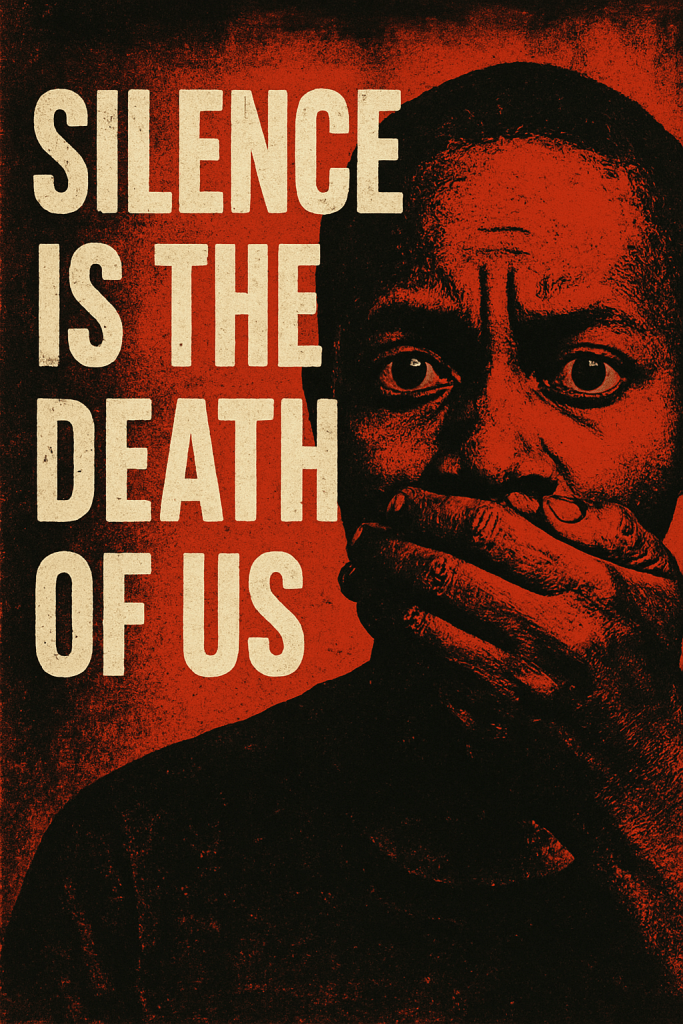
SILENCE IS THE DEATH OF US

Dear Corporate,

I know you like your linen white.
White as milk.
With no stains, no creases,
And no voices too loud or opinions too strong.
You want clean reputations,
Clean photos, clean silence.

You like me better
When I just show up, smile, hit targets,
Say “yes sir” to everything and go home.
You like me better
When I keep the fire in my belly out of your boardroom.
When I don’t question, when I don’t care too much.

But here’s what you forget,

I was me before I became your employee.
I had a voice before I had your email signature.
I had convictions before I had a clock-in code.
And I’m not about to trade all that in
For job security and polite applause.

I love justice.
The same way you love KPIs.
I care about this country,
The same way you care about brand image.

So when you see me at a protest,
Don’t flinch.
I’m not unstable.
I’m not rebellious.
I’m just awake.

When I call out corruption,
I’m not ruining your name,
I’m protecting it.
Because if systems rot,
Your success does too.

When I tweet in anger,
It’s not because I’m angry all the time.
It’s because I still believe that things can change.
That voices matter. That silence is too heavy to carry anymore.

I’m not asking for much.

Just this,
Don’t punish me for caring.
Don’t blacklist me for believing.
Don’t put me in a corner
Because I refuse to play blind.

I want to work.
I want to grow.
But I also want to live in a country where truth doesn’t cost you your job.

Let me speak.
Let me stand.
Let me protest, cry out, and still walk into your office on Monday morning with purpose.
Because fighting for what’s right
And showing up for work
Aren’t enemies.
They’re both signs I give a DAMN.

So no,
I’m not mad.
I’m not disloyal.
I’m just patriotic.
And I won’t whisper that.

Sincerely,
Still the right person for the job. Just louder.

@okelododdychitchats

Silenceisthedeathofus #Speak #PoeticJustice #Justice #Justice4AlbertOjwang #SpeakUp #Corruption #EndCorruption

It’s Colonial, I Swear

What happened before the roses came ?

1. Cold Showers and Pink Suits

There’s a special place in hell for cold showers and it’s probably somewhere next to the queue at the passport office. And now you want me to willfully take one, shave, powder my neck, and wear that pink suit that makes me look like a soft loan? Just to go out on a date? Bruh. That’s not love; that’s martyrdom. I did not survive Nairobi water bills to be out here moisturizing for cold balconies and cappuccino dust.

2. Love in the Time of Third Parties

Who even decided that love needs to come with an invoice and VAT? Dating in this economy feels like trying to start a business on a chama budget. You spend thousands to sit across someone in a place where both of you are silently trying to gauge who is more emotionally unavailable, while the waitress thinks you’re about to propose.

3. The Whitewashing of Romance

Let’s talk about it: is the modern date a colonial export? Imported like jazz music and instant noodles? Because, really, how did our grandfathers do it? They didn’t need a date. They needed a strong back, a hoe, and a keen eye for dowry negotiation. Now we’re out here buying roses that die in 48 hours, basically love-shaped perishables and calling it romance.

4. Introverts Anonymous

I’m not antisocial. I’m pro-solitude. There’s a difference. Why must love always be on display, like it’s a talent show and we’re all auditioning for the role of “Emotionally Available Partner ”? Me, I prefer my affection with a side of silence. Just Netflix algorithms that understand me better than most people.

5. The Psychology of Smashing vs Smiling

Some dates feel more like interrogations with ambience. You’re sitting there, trying to chew tasteless pasta gracefully while wondering if she thinks your smile means “I like you” or “I’m just horny.” You’re sweating from trying to remember if you mentioned you were raised Christian or spiritual but not religious.

6. Date Inflation & Emotional Capitalism

Who decided that love must be shown through receipts? That emotional availability must be measured by how many brunches you’ve paid for? I’ve dated women who thought the absence of fine dining was the absence of love. Hey, the pepper in my githeri is a form of affection. Don’t let capitalism gaslight your heart.

7. Domestic Love, Anyone?

Let’s stay home. I can cook, I can serve, and I can even throw in bad jokes for seasoning. No need for that performative laughter at Java. I want us barefoot in the house, arguing about how much salt I put in the food. That, my friends, is real bonding. And I can pause to pee during the movie without missing the plot or the bill.

8. Public Displays of Affection Fatigue

What’s so romantic about someone interrupting your moment to ask “would you like sparkling or still?” Let me love you in sweatpants. Let’s laugh over burnt ugali. Let’s fall asleep on opposite ends of the couch and meet halfway in a dream. That’s the kind of love that doesn’t make it to Instagram, but lasts.

9. Love Without Logistics

The planning of dates stresses me more than the dating itself. Reservations, rides, fitting into attires from 2021, it’s a full-time job. Why can’t we date like we used to play kalongo in childhood? Spontaneous, anarchic, and mostly in someone’s house with limited adult supervision.

10. Let’s Redefine Romance

So no, I’m not taking cold showers for a warm table. That doesn’t mean I love less. I just love differently. Quietly. Deeply. With less garnish and more substance. If love is a language, I speak it fluently in slippers and home-cooked meals. The balcony is cold, the city is expensive, and my pink suit is for weddings only. Choose your battles wisely. Choose your love even wiser.

@okelododdychitchats

Holy Hypocrisy

Why did I stop going to church? One of the funniest reasons I’ve heard is, “My pastor was crippled and healing cripples. Like, why not heal yourself?” It’s a dark statement, but I get where they’re coming from. Let’s be honest, are these people God’s messengers or money makers in Poverty Pulpits ?

I believe in God, but I have a million questions. My friend and colleague, Evans Asudi challenges me every time we have a discussion about religion and the existence of God, he argues that the design of the universe, nature, and everything in it must have an origin. My question is, is that origin the God of the Christian Bible, Allah of the Muslim Quran, or the supernatural forces in Buddhist texts like the Tripitaka? I’m not saying these religions worship entirely different gods. They argue as if they do, but interestingly, they all seem to agree on the same devil. Crazy, right? Anyway, I believe in God and identify as Christian, but I rarely go to church. I have my reasons !

As a kid, I always questioned my existence, and while that hasn’t changed, I now find myself questioning the origins of religion. Who created it, and what was it really meant to achieve? History shows how religion has been used to create divisions, often for political gain, and it still happens today. Different religions hold varying beliefs, and even within Christianity, denominations clash. Paul even addressed this in Corinthians, questioning why Christians were divided when they were all baptized in Christ’s name. These divisions are often exploited for political purposes, given the strong influence religion has on society and politics.

I was raised in a strict Christian background where questioning the church or its leaders was off-limits. It was considered disrespectful and even thought to bring curses. Looking back, I laugh at how much I used to fear that. But, even as a kid, I could see pastors giving in to “earthly” temptations, sins they were never held accountable for. They seemed untouchable, immune to any form of criticism. Over time, this made me start questioning things more deeply, and now it’s part of why I find it difficult to step inside just any church today.

To make sense of where we are, let’s start with the history of Christianity. It began in the 1st century after Jesus’ death as a Judaic sect with some Hellenistic influences. The Catholic Church claims to be the original, with the first church said to be in Jerusalem. Over time, Christianity branched into several groups like the Church of the East, Oriental Orthodoxy, Eastern Orthodoxy, Roman Catholicism, Protestantism, and Restorationism.

In its early days, the traditional churches built schools, hospitals, and provided services that genuinely benefited the community. They did this without exploiting their congregants. But as time went on, evangelical churches started popping up what one of my great of all time writer, Chimamanda Ngozi Adichie calls “mushroom churches” in her book “Purple Hibiscus”. I’m not generalizing all evangelical churches, but many sprouted after the colonial period, often without any regulation, and some have become quite problematic.

These churches often target vulnerable people, especially our mothers. With this, sometimes, I tend to believe that the colonialists had a plan,  schools for the children, prisons for the fathers, and churches for the mothers. Anyway, that’s just a detour, let’s get back on track…A lot of these churches manipulate their followers, brainwashing them into accepting whatever the pastor says without question while reasoning that questioning will lead to the unthinkable,absurd! When pastors claim that questioning them will lead to whatever, it’s really just a way to manipulate their followers. You don’t fail or fall by speaking up or seeking answers for God’s sake !

Times without number, I’ve also heard pastors glorify poverty, insisting that wealth distances you from God, they say that having money makes you less inclined to pray. These same pastors live in luxury, strikingly paradoxical ! Some even discourage their followers from seeking medical help, claiming that doing so demonstrates a lack of faith in God, despite the Bible stating, “faith without action  is dead.” Are they referring to something who’s content they do not understand or did it change overnight ?

It’s ironic how these extreme churches often have the largest followings. And what really frustrates me is the constant fundraising, with no transparency on where the money goes. I’m tired of seeing congregants grow poorer while pastors grow wealthier. Churches should be shaping and speaking up for the community, but many stay silent when it doesn’t affect them…I am just sick and tired of this top tier deception, emotional control, psychological tactics, coercion, gas lighting, name it all! let me take a break! One day, we’ll go deeper into this, especially on how pastors are now called “Daddy” and their wives “Mummy.”

@okelododdychitchats

If I Fail to Wake Up Tomorrow

If I fail to wake up tomorrow,
Know that I fought with all my might
Against the demons that plagued my mind
I battled through the darkness
But in the end, I couldn’t find the light
My soul was weary, my heart was tired
And I found solace in stepping into eternity,

If I don’t wake up tomorrow,
Tell my friends I’ll miss them dearly
The laughter, the memories, the tears we shared
Will forever be carved  in my  silent whispers lost in time
I hope they find peace in knowing
That I am finally free from the pain
That haunted me every waking moment
I’ll be watching over them from above

If I fail to wake up tomorrow,
Promise me you’ll take care of yourself
Don’t dwell on what could have been
Live your life to the fullest, cling to the warmth of joy
That I could never fully appreciate
Treasure like gold every sunrise, every sunset
And know that I am always with you
In spirit, in memory, in love

If I don’t wake up tomorrow,
Tell the world my story
Let my struggles be a lesson
That mental health is not a joke
That a smile can hide a world of hurt
And that reaching out for help
Is not a sign of weakness, but of strength
Break the stigma, break the silence

If I fail to wake up tomorrow,
Know that I am at peace
No longer shackled by my fears
No longer drowning in my tears
I am free to soar amongst the stars
To dance in the moonlight, to bask in the sun
I am finally whole, finally content
In the arms of endless rest.

Let my legacy be one of love
Of kindness, of compassion
And may my journey to the beyond  bring awareness
To the struggles we all face
So if I fail to wake up tomorrow
Know that I am at peace
And that I will always be watching over you
From the heavens above.

@okelododdychitchats

Niskize

You don’t know the battles I’ve fought
The struggles I’ve faced !
You don’t realize the depth of my sorrow
So before you judge, just wait, niskize !

Don’t mock me with your words of scorn
Don’t criticize me from dusk till morn
Your harsh remarks don’t offer insight
They only push me further from the light

My pain runs deep, it’s a part of me
It’s only I who truly see
The struggles I endure day by day
So take a moment, niskize !

I may seem weak when tears fall down
But crying is my way, my sound
Of releasing the pain that weighs me down
Of letting go of the burdens I’ve found

Don’t label me as frail or meek
Just listen to the words I speak
I have a story that needs to be told
A tale of pain and  courage bold

So before you pass judgment on me
Take a moment, niskize !
The strength it takes to face each day
To keep going despite the wear out

I am not defined by my tears
But by the battles fought through the years
So next time you see me cry
Remember, it’s not a sign of weakness, but of strength inside

Don’t underestimate the power of a tear
The release it brings, the healing near
So before you speak, just listen first
To the story of pain and hurt

I may not be what you expect
But my strength lies in the tears unchecked
So listen to my words, my plea
And see the true strength in me.

@okelododdychitchats

Still, I am

I didn’t get the privilege of being born in a hospital. My mother labored in my grandmother’s smoky kitchen. They were with my late father, who tried rushing her to Lwak hospital, but I grew weary of the womb’s care for, I was eager to taste the world’s sweetness and bitterness alike, I had to step into the light and meet it head-on. I came out right outside the fence, and my grandmother, Stella or if you like  Min Ombewa, delivered me.

I was born in Asembo, my paternal home. A place I hardly know, a place I hardly visit, but a place I recognize much with. That’s why I call myself Jakolal, because Kolal is my village,Kolal is in Asembo.

When I was four, wait, I didn’t get the chance to be light-skinned when I was born. Kids are often light when birthed, but the colors of their skin often change after tasting the different rays of the sun. Their skin changes, picking the shades of their parents’ skin. Biology calls it genetics. The point is, the skin changes and sometimes becomes hard with pimples on the face and sometimes with a lot of hair standing straight on the surface. They change! I was dark at birth, and still, I am. My father, Isaiah Oguta Ngesa Nyakwar Okelo found a way of making me comfortable wearing the dark skin. He called me Rateng‘. Rateng’ means black. He narrated to me during free time how well black is priceless as the first breath of dawn after a long night. I love black ! Black is beautiful. I love my skin. I owe it to my dad.

One night after his karate sessions, he complained of pains. My mother says  it was sharp pains that gripped his chest, something like asthma, yet they called it typhoid. I still wonder how chest pains and typhoid dance together in the same space. He was rushed to Aga Khan Hospital Kisumu, and on February 14, 2002, he slept, closed his eyes eternally. His brain stopped functioning. Everything in his world stopped. He rested. Mama was only 26. I am told she was only earning Ksh. 1000 as a Board of Manager teacher. She had kids and a family to take care of. She remained strong, productive and everything positive. We never lacked. We never knew poverty. We saw all good and got at least everything we wanted. I just didn’t get to practice karate anymore because my company was gone! After he was gone, he took the name Rateng‘ with him. Nobody else knew me as that. Nobody called me that except my uncle, Dr. Odongo. But with that alone, I knew how priceless my skin color was. I wore it with courage growing up. I miss the one who made me comfortable in it, but fate had just brought it that way. Sad!

Forget that though. My mother left footprints of success in the sands of time. She did all a mother could and more, and that’s why I hold her dear. That’s why my best sentence begins with the word “Mum.” My definition of love begins with the word “Mum.” My definition of beauty begins with the word “Mum.” My definition of strong begins with the word “Mum.” Her display of substance and appearance makes her just the best. She is the best!

This doesn’t concern you, but I am still dark. My mum is dark too. We wear this fine melanin, black chocolata skin with beauty and pride.

@okelododdychitchats

Why

Why does misunderstanding want to steal my love for you
But why does myopicness cloud my vision of our future
Why does laziness rob me of the riches I wish to share with you
And why does ego deceive me into thinking listening is a weakness
Why does society label submission as toxic masculinity
Yet everything appears hazy, not from desire, but from perception

Why does social media pressure me to doubt our worth
Why does society foster division between our tribes
When our chemistry is as seamless as water mixing with wine
Why do these barriers threaten to break us apart

Misunderstanding lurks in the shadows, waiting to strike
Myopic eyes fail to see the beauty in our shared destiny
Laziness creeps in, stealing the potential of our union
Ego whispers lies, poisoning my willingness to listen
Society’s expectations weigh heavy, clouding my judgment
Yet deep down, I know our love is pure and true

Social media may try to plant seeds of doubt
But I know our worth, our bond unbreakable
Society’s labels cannot define the love we share
Our tribes may be different, but our hearts beat as one

So I will fight against the forces that seek to tear us apart
I will silence the doubts and fears that threaten our love
For in the end, it is only you that I see
And nothing will ever come between you and me.

@okelododdychitchats

Black is Beautiful

I am a black kid, they say, a child of the night
With skin as dark as the ebony sky
But is black truly beautiful, or just a lie?
A lie told to comfort those who fear the unknown
I am rich in melanin, they say, but is it a gift or a curse?
My rough, hairy skin a canvas of deep brown hues

They say black ain’t good enough, sio rangi ya thao
That beauty lies in lighter tones, like vanilla or cream
But what about the beauty in diversity?
In the rich shade of colors that make up humanity
Should I be bold with my blackness, embrace it with pride?
Or hide in shame, letting their words pierce my fragile heart

I try to see beauty in my reflection, but all I see is darkness
Ugly thoughts creeping into my mind, telling me I’m less than
Forget my big ears, they say, it’s all about my skin
My skin that marks me as different, as other
They call me a monkey, comparing my hair to fur
As if my blackness makes me less than human

I walk the streets with my head held low
Feeling the weight of their stares, their judgment
They see a criminal in me, not a child
A child with dreams and hopes, just like any other
Do I not belong to this world, to this society?
Or am I destined to always be an outsider

But I refuse to let their words define me
I am more than just a shade of black
I am a child of the night, yes, but also a child of the sun
I am rich in melanin, my skin a testament to my roots
I am beautiful in my own right, in my own way
And I will walk with confidence, no matter what they say

So let them call me black, let them call me ugly
I will wear my darkness like a crown
For I am a black kid, proud and unapologetic
A reminder that beauty comes in all shades
And that true beauty lies in the eyes of the beholder
I am a black kid, and I am beautiful.

@okelododdychitchats