Crunchy Honest Chips

I was born just outside my father’s home. I mean outside the fence. Not in a hospital. Not in some sterile maternity ward with nurses who smell like Dettol and sigh through masks. No. I came into this world the traditional way, on ancestral soil, barefoot and bold, like a true son of Asembo. My grandmother delivered me. I’ve said this before, and I’ll say it until my tongue is weary, it’s something to be proud of. It’s raw. It’s traditional. And I guess, so am I.

Asembo is about 15 minutes away from Raila’s Opoda Farm. But this is not about him. This is about home. Or the idea of it. Because although I was born there, I didn’t grow up there. In fact, it took me seventeen years to return. And when I finally did, with the awkward gait of a visitor in his own past, I found our home was no longer a home. It had become a farm.

The only proof we were ever there are the graves—traces of my father, my uncle, my grandmother, and my grandfather. The cement doesn’t crack. It holds secrets. They told me the land is mine now. Or at least part of it. My father was the last born, and in our traditions, that means the home was his. By extension, now mine. But what do you do with a piece of land full of ghosts?

There’s another parcel—12 acres or so. I didn’t earn it. Didn’t break my back for it. Didn’t argue with chiefs or attend land tribunal hearings in stuffy rooms with men who say “utu ni utu” before betraying you for a bribe. It was passed to me like a baton in a relay. A gift from the dead. So no, I’m not bragging. And even if I was, who really wants to sweat for something they can get for free? This is Kenya, after all. We queue for handouts and call it luck.

I grew up in bits and pieces—Homa Bay, Kisumu, Rongo. Like a nomad in search of permanence. In 2007, my mother built a modest house in Rongo. That’s home now. We live there with strangers who’ve since become family, the kind you don’t choose but grow into like an oversized sweater that slowly starts to fit. In Rongo and almost everywhere else in Luo Nyanza, people intermarry—Luos, Luhyas, Kisiis. But not Kikuyus. No, Kikuyus are where the line is drawn.

Luos hate Kikuyus and Kikuyus hate Luos. That’s the story we were handed by the colonialists—wrapped in propaganda and sprinkled with enough suspicion to last generations. Divide and rule. And rule they did. Now we inherit the hate like old family furniture we’re too proud to throw out. We say things like: “A Luo is a witch with a sack of rituals on his back” or “A Kikuyu is greedy and selfish” or that “Kikuyu women kill their husbands.” What is that? That’s not wisdom. That’s premium-grade poetic cow dung.

Ask anyone for proof, and they’ll stutter like a bad radio signal.

I don’t believe in what I haven’t seen. I won’t condemn a whole tribe because Otieno once borrowed your charger and never returned it. Or because Wanjiku blocked you on WhatsApp after you bought her chips kuku.

If that makes me fallacious, then call me a walking fallacy.

And listen, Kikuyu women are beautiful. Not the stereotypical light-skinned, big-chested, flat-behind and thin legs that don’t  match the body types, those that your uncles warned you about. No. These days, they come in thick—size sevens with curves that look like they were negotiated in parliament. Faces sculpted like the gods used cheekbones as currency. And thighs, God help us, thighs the colour of roasted cashews—thighs that can save entire nations.

I’m dating one. A Kikuyu. Six years now, give or take a few breaks that almost broke us. Her name is Koi, but if you know her like I do, you call her Spiky. And Spiky? Spiky is divine.

Spiky is what you’d get if elegance had a baby with audacity. She walks like confidence and still laughs like she was raised by love. Her skin is caramel dipped in honey, the kind that makes you wonder if sunlight took lessons from her. Her smile is a gospel that can turn a hard man soft. She’s smart, too. Smart with the kind of intelligence that knows when to speak, when to keep quiet, and when to look at you in a way that makes you question all your life choices.

Her body is poetry. The kind of body that makes you want to write odes in traffic. Her mind is a map. Her heart is a home I keep returning to. Even when I say I’m done.

I am not here to convert you. I am just here to say—love is not tribal. Neither is beauty. Neither is home.

Some of us were just born outside, by grandmothers with hands strong enough to deliver a future.

And maybe that’s enough.

It was 2AM or thereabouts. You know that hour that’s neither here nor there—when the silence feels staged, like the night is watching you back. I wasn’t asleep, of course. My insomnia is back. It always returns like an old lover who doesn’t knock, just walks in and makes itself comfortable.

Spiky was up too, prepping for one of her strange shifts. She works those ungodly hours, where your body wants to rest, but capitalism wants a report submitted by 5:45AM. I decided to keep her company, texting back and forth. In the middle of our banter—whose contents I won’t get into, partly because I’m lazy and partly because it might send you off on a tangent—we veered into a detour.

There’s a Mugithi na Ndumo at Red Room from 2PM,” she texted. “Come with me?”

Mugithi is a Kikuyu genre—think of it as country music that drank a full bottle of Muratina and decided to wear a hat. Ndumo is the dance—the erratic, shoulder-driven, hip-twisting rhythmic warfare. It’s like watching a fight that no one wants to break up. I don’t speak Kikuyu. I know only “mbesha shigana?” which loosely translates to “how much money are we wasting here?” But I said yes. Because love is also showing up where you don’t belong and hoping the rhythm saves you.

Google Maps says Red Room is in Kilimani. Technically true. It’s on Adlife Plaza. But if you follow those blue dots on Google blindly, you’ll find yourself in West Pokot or emotionally lost. Take my advice: get to Yaya Centre, take that left turn. Adlife Plaza is a few blocks in, across from Shujah Mall. Red Room lives on the first floor.

The place is cool.  Genuinely cool. It’s shaped like an L, as if someone folded the club and forgot to unfold it. The counter sits at the center like a bartender god. There’s a stage—clean, slightly elevated, and a DJ booth carved with intention, not just dumped there. The seats in the regular area are metallic, but not the koroga kind. These ones have cushions that hold your secrets. They are comfortable. The VIP area, of course, has better seats—those white kinyozi-waiting-area chairs, only here they’ve been baptized and saved.

The roof is translucent, high enough not to threaten your dignity, and there’s space to dance without knocking a stranger’s elbow. The floor is plastic turf. That fake grass that doesn’t pretend to be real anymore. The kind you’d find in a cool rooftop bar, or a child’s playground where no one gets hurt when they fall—except emotionally.

Our waiter is polite. Genuine. The kind that makes you want to tip even when you’re broke. We order goat meat and chips not fries. I refuse to gentrify potatoes. Spiky, glowing like the first sip of good wine, is in wide-legged purple pants stitched by a fundi who understands women. Her top—a crocheted piece of African fabric art—is from the same fundi. She looks like Nairobi confidence dressed in culture. I’m in wide-legged pants too (no judgment), a free shirt I got from Dura Poa and my trusted white Converse. I order a litre of Muratina because, well, when in Rome… get tipsy on their traditions.

Spiky orders two bottles of Kenya Originals.

The food comes and we eat because what else do you do when food comes? Their meat is soft. Tender like it was raised by a grandmother with a kind voice. The chips are golden and crunchy—honest chips, not those oily, sad ones that taste like heartbreak.

Then comes Gasheni. She wasn’t on the lineup, just a curtain raiser. But sometimes curtain raisers leave you wondering why the main act even bothered. She did well. She cleared the path like John the Baptist. And when DJ Dibull came on, he walked through like the Messiah of sound. He played magic. I danced. I didn’t understand a single lyric but my body understood the beat, and sometimes, that’s all that matters.

Tony Young came in next. One hour and thirty minutes of pure Kikuyu Vaibu. By the time Waithaka Wa Jane got on stage, I think the crowd was tired. Or maybe he was just too mellow for 11PM energy.

Ah, I almost forgot—DJ 44. That man spins like he’s in love with every beat. Like each song owes him rent.

At our table, a couple and a lady joined us. Later, a guy.   All of them were vibes. They figured out pretty quickly that I wasn’t Kikuyu—maybe it was the way I danced, like someone dodging potholes. But they embraced me. One of them told me, “If you can’t beat us, join us.”

So I did.

And I’ve invited them to the Luo Festival on the 9th of August. There, I’ll beat them. And they’ll join me. And we’ll call it unity.

Mugithi was greatness. Pure, fermented, cultural greatness. The kind that reminds you that sometimes all it takes is a beat for you to remember how good it feels to just live.

Thank you for this Spiky. I loved it Baby!

@okelododdychitchats
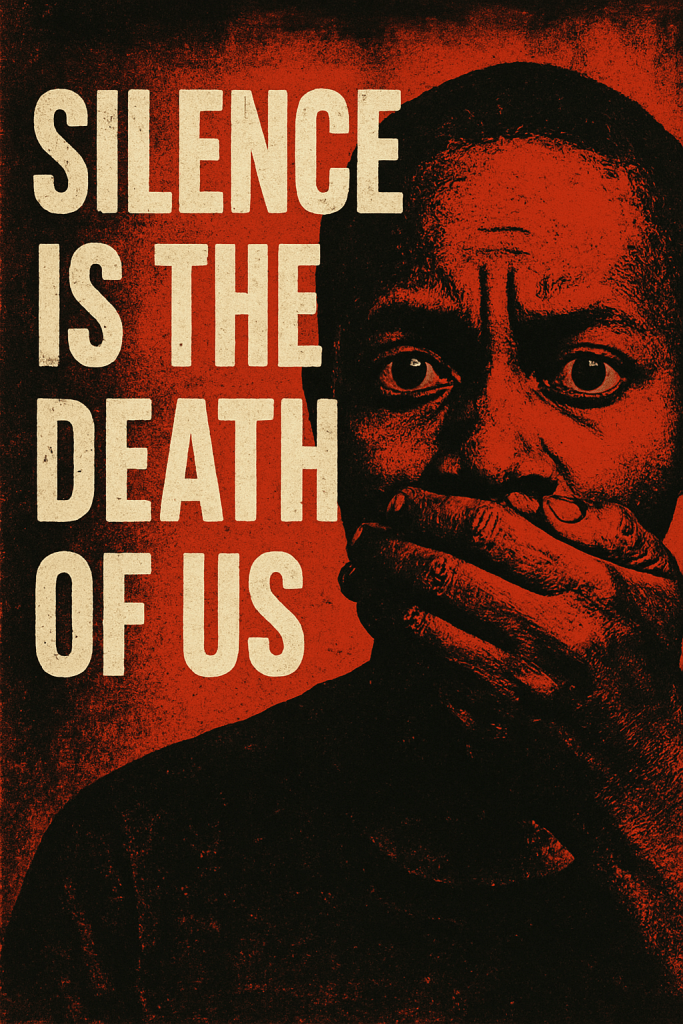
SILENCE IS THE DEATH OF US

Dear Corporate,

I know you like your linen white.
White as milk.
With no stains, no creases,
And no voices too loud or opinions too strong.
You want clean reputations,
Clean photos, clean silence.

You like me better
When I just show up, smile, hit targets,
Say “yes sir” to everything and go home.
You like me better
When I keep the fire in my belly out of your boardroom.
When I don’t question, when I don’t care too much.

But here’s what you forget,

I was me before I became your employee.
I had a voice before I had your email signature.
I had convictions before I had a clock-in code.
And I’m not about to trade all that in
For job security and polite applause.

I love justice.
The same way you love KPIs.
I care about this country,
The same way you care about brand image.

So when you see me at a protest,
Don’t flinch.
I’m not unstable.
I’m not rebellious.
I’m just awake.

When I call out corruption,
I’m not ruining your name,
I’m protecting it.
Because if systems rot,
Your success does too.

When I tweet in anger,
It’s not because I’m angry all the time.
It’s because I still believe that things can change.
That voices matter. That silence is too heavy to carry anymore.

I’m not asking for much.

Just this,
Don’t punish me for caring.
Don’t blacklist me for believing.
Don’t put me in a corner
Because I refuse to play blind.

I want to work.
I want to grow.
But I also want to live in a country where truth doesn’t cost you your job.

Let me speak.
Let me stand.
Let me protest, cry out, and still walk into your office on Monday morning with purpose.
Because fighting for what’s right
And showing up for work
Aren’t enemies.
They’re both signs I give a DAMN.

So no,
I’m not mad.
I’m not disloyal.
I’m just patriotic.
And I won’t whisper that.

Sincerely,
Still the right person for the job. Just louder.

@okelododdychitchats

Silenceisthedeathofus #Speak #PoeticJustice #Justice #Justice4AlbertOjwang #SpeakUp #Corruption #EndCorruption

It’s Colonial, I Swear

What happened before the roses came ?

1. Cold Showers and Pink Suits

There’s a special place in hell for cold showers and it’s probably somewhere next to the queue at the passport office. And now you want me to willfully take one, shave, powder my neck, and wear that pink suit that makes me look like a soft loan? Just to go out on a date? Bruh. That’s not love; that’s martyrdom. I did not survive Nairobi water bills to be out here moisturizing for cold balconies and cappuccino dust.

2. Love in the Time of Third Parties

Who even decided that love needs to come with an invoice and VAT? Dating in this economy feels like trying to start a business on a chama budget. You spend thousands to sit across someone in a place where both of you are silently trying to gauge who is more emotionally unavailable, while the waitress thinks you’re about to propose.

3. The Whitewashing of Romance

Let’s talk about it: is the modern date a colonial export? Imported like jazz music and instant noodles? Because, really, how did our grandfathers do it? They didn’t need a date. They needed a strong back, a hoe, and a keen eye for dowry negotiation. Now we’re out here buying roses that die in 48 hours, basically love-shaped perishables and calling it romance.

4. Introverts Anonymous

I’m not antisocial. I’m pro-solitude. There’s a difference. Why must love always be on display, like it’s a talent show and we’re all auditioning for the role of “Emotionally Available Partner ”? Me, I prefer my affection with a side of silence. Just Netflix algorithms that understand me better than most people.

5. The Psychology of Smashing vs Smiling

Some dates feel more like interrogations with ambience. You’re sitting there, trying to chew tasteless pasta gracefully while wondering if she thinks your smile means “I like you” or “I’m just horny.” You’re sweating from trying to remember if you mentioned you were raised Christian or spiritual but not religious.

6. Date Inflation & Emotional Capitalism

Who decided that love must be shown through receipts? That emotional availability must be measured by how many brunches you’ve paid for? I’ve dated women who thought the absence of fine dining was the absence of love. Hey, the pepper in my githeri is a form of affection. Don’t let capitalism gaslight your heart.

7. Domestic Love, Anyone?

Let’s stay home. I can cook, I can serve, and I can even throw in bad jokes for seasoning. No need for that performative laughter at Java. I want us barefoot in the house, arguing about how much salt I put in the food. That, my friends, is real bonding. And I can pause to pee during the movie without missing the plot or the bill.

8. Public Displays of Affection Fatigue

What’s so romantic about someone interrupting your moment to ask “would you like sparkling or still?” Let me love you in sweatpants. Let’s laugh over burnt ugali. Let’s fall asleep on opposite ends of the couch and meet halfway in a dream. That’s the kind of love that doesn’t make it to Instagram, but lasts.

9. Love Without Logistics

The planning of dates stresses me more than the dating itself. Reservations, rides, fitting into attires from 2021, it’s a full-time job. Why can’t we date like we used to play kalongo in childhood? Spontaneous, anarchic, and mostly in someone’s house with limited adult supervision.

10. Let’s Redefine Romance

So no, I’m not taking cold showers for a warm table. That doesn’t mean I love less. I just love differently. Quietly. Deeply. With less garnish and more substance. If love is a language, I speak it fluently in slippers and home-cooked meals. The balcony is cold, the city is expensive, and my pink suit is for weddings only. Choose your battles wisely. Choose your love even wiser.

@okelododdychitchats

Tomorrow is Friday Guys!

People used to smell like One Million and 212, those who had stretched their pockets just enough to afford a whiff of something slightly premium. Not premium-premium, just one million with a funny logo and a scent of 212, sometimes rebranded as 242. But at least they tried. At least they smelled nice. That was the point. 

Now everyone smells of Yara. Including the lady seated next to me in a maroon cardigan, white top, and black pants and sneakers—coincidentally, just like me. Someone might think we are together, or worse, on some synchronized promo for maroon, black, and white outfits. But no. We are not together. I just know she has done her hair well, and she smells of Yara. I am actually even too shy to look at her face again but I know she’s wearing pink nails. I mean I can see her nails…

I don’t know which Yara she’s wearing, but I’ll assume it’s the good one because she looks expensive. Expensive like an iPhone 15. 

And yes, she has an iPhone 15. A whole Pro Max. And you know, owning an iPhone is already rich (So we think). A whole 15 Pro Max? That’s generational wealth. That’s “my uncle works at UN” money. That’s “I don’t ask for prices before ordering” kind of money. 

Now, unless the SI unit for expensive and richness changed overnight (It used to be or still is an Iphone), I am confused. I mean, is she rich-rich, or is this the “niongeze ten bob ya Kutoa “  type of babe? You know, the one where someone casually flexes their iPhone but deep down, their Fuliza is gasping for air, their M-Shwari is in ICU, and their branch loan officer knows them by name? Because here she is, sitting in a Kasarani-bound bus, scrolling like she’s never been in a financial group chat discussing “nani alishikwa na Tala?”

She keeps smiling, and I keep wondering, has she ever walked through the sardine-packed chaos of Mfangano Street? Has she ever set foot in that mall-that-is-not-really-a-mall called Cianda and tried to pronounce it? But then I dismiss the thought. We are all in the same loud bus to Kasarani. I convince myself she lives in Sunton. And I’m not saying Sunton isn’t classy. I’m just saying it’s affordable class. But forget that ! – Just know, she’s pleasing to look at. The kind of person you’d instinctively place in Kilimani, yet here we are, and Sunton is the reality. At least she smells nice. 

I have just left three government offices, and for the first time in my twenty-guess what years of living, I have not been served with attitude. I’m beginning to think the only ones who throw attitude are the Sub-County office folks because these ministry guys? They have mastered the art of hospitality. If only their bosses were the ones delivering services to us daily, ningefurahia!

But for now, I am just a happy man. Happy to sit next to someone who smells nice. Happy that, for once, I have not inhaled the unfortunate concoction of refilled Invictus mixed with a random scent that dares to bear Beyoncé’s name. Happy that three government offices served me without the signature “rudi after two weeks” response. Happy that I have finally cleared a backlog of work. 

I haven’t slept since Saturday. Today is Thursday. 

Tomorrow is Friday, guys.

@doddyokelo

@okelododdychitchats

Lady in Black


Mimi ni wa kucum, oh, scrap that, my bad, I meant Mimi ni wa kucome.’”
I was raised in the village. Well, not really a village because Rongo qualifies as a town, but Nairobians will still call it Moshadha, or ushago, or something else altogether. Forget it. 
I grew up in Rongo for most of my childhood and only moved to Nairobi for campus. That’s right, I went to Multimedia University of Kenya in Karen, Nairobi County. Before anyone comes at me with, “Multimedia iko Rongai, bro,” before we argue, check your maps! The lower fence of Multimedia separates Nairobi from Rongai in Kajiado County. So yes, I schooled in Karen and stayed in Karen for four years. Si ni Mimi nawashow.

I bring up this whole kukucome thingie because when I first got into the Nairobi scene, matatu touts kept shouting “Tao Amboseli,” I didn’t catch it right, so I genuinely thought every estate in Nairobi had an Amboseli, just like almost every hood has a Kwa Chief in it. Turns out, they were saying “Tao hamusini,” as in, fare to town was 50 bob from wherever the pickup point was. Today, I’m in one of the moderately pimped Mapepe mats of Utimo Sacco. It’s carrying Tao Hamusini from Umoja Jeska stage. It’s Almost full. People love it because the driver here, knows how to dodge traffic….I’m sitting in the back, on the left window seat, giving me a clear view of everyone getting in, and, of course, judging them. Before I’m done profiling my fellow passengers, a lady slides in beside me. She’s today’s topic. This is udaku for free, feel free to share it with your crew. I hear y’all love udaku, so buckle up.


She’s in a sleek black dress, paired with not-so-new maroon Nike TNs, probably Kamukunji stock, judging by the soles, which haven’t been worn down by exposure to air (yes, I noticed the shoes when she stepped in, don’t ask). Her makeup is flawless, compensating for her questionable style. Thick lenses with frames hugging her round face sit perfectly on her. 
Her eyes? Twin pools of wonder and mystery, they speak in whispers, framed by lashes as soft as a lover’s caress. 
Her lips? Succulent and juicy. 
Her nose? Perfectly symmetrical. 
Her face is a masterpiece on a perfectly sculpted body. 
Her hips don’t lie. When she sits, our hips meet, and I feel something, a desire mixed with comfort and curiosity mingling with hunger. Unsettling and oddly familiar.

I don’t know her name, but I know she smells nice, her dreadlocks are freshly done, clean, and not a hint of dusty brown in sight. 
The bus starts moving, and she turns to me. 
“You look good,” she says. 
So do you, I think. 
“You smell nice,” she adds. 
So do you, I think again. 
Match made in heaven, I convince myself, until she starts talking. And talking. And talking. A relentless stream of words. This river has no banks. Suddenly, I’m not so sure. I reconsider my initial instincts about asking for her name or number. 

She pulls out a Juicy Fruit from her Gussii bag (yes, that’s what it says, probably meant to say Gucci). The way she chews it… carefree, wild, tasting life with abandon. It’s unbothered. It’s maddening….

We are in Town now,

When we reach past Mfangano Street, she turns. 
“What’s your name?” 
I tell her. 
She smiles and walks away, heading toward Luthuli Avenue. 

I watch her walk. That dhudha (that’s ass in some local sheng language.) That graceful stride. That hypnotic sway. 
And for a fleeting moment, I wonder if I could’ve traded all that talking and careless chewing for the simple joy of watching her disappear into the crowd…

I almost get knocked down by a bike. As I snap back to reality, I realize it’s partly my fault. This part of town is always packed with people and matatus. When you mix those two, it feels like the sum of mchanga wa bahari, a bit of an exaggeration, but downtown Nairobi CBD is always a madhouse. I apologize to the boda guy and keep walking toward Nyayo House, with the lady in black still on my mind… I’ll tell you this, if you meet someone in a matatu or anywhere else who catches your interest, don’t wait around. Go for it. Take the risk! The guilt of not trying is way worse than whatever the outcome might be. I wish I’d gotten her number, even if it ended up on that list of contacts I don’t talk to. At least I’d have it, and what I choose to do with it is on me.

All day, I can’t stop thinking about the lady in black. She’s in my thoughts, even in the words I’m about to say. I try to dodge the usual chaos of the crowded streets, so I take a detour towards Kencom, then City Hall. It’s quieter here, with less hustle, and the buildings are lined up neatly, giving off this calm vibe. It’s the kind of peace that lets me think about the lady in black without anything pulling my attention away.

As I get closer to Nyayo House, I notice the street next to Cardinal Otunga and Holy Basilica is lined with Kienyeji ladies, each with an eye on the crowd. They’re advertising cyber services, not with signs, but with their words “bro, cyber, printing…” They’re looking for people who might need a printout or scan before heading into Nyayo House. Their smiles say they’ve seen it all, and they walk with the kind of confidence only Nairobi’s hustle can teach.

I don’t need any cyber services today, so I head straight to the NEMA offices to meet the Nairobi County Coordinator. Her office is warm and welcoming, and one day, I’ll ask her for an interview. But today, I’m here for something else.

Catch you later, guys!

@okelododdychitchats

Behind the Walls

In this city’s very soul, behind its walls
There’s a hidden place, where poverty does not pass by.
A settlement, with huts made of tin,
The streets are littered, and the air is thin.

Here, order is but a dream,
Children roam the streets, with nowhere to be seen.
Their playgrounds are filled with rubbish and waste,
Their homes are cramped, with no sense of taste.

The stuffed room they call home, with everything thrown everywhere,
Is a sight to behold, a scene of despair.
Toys lie scattered, amidst piles of clothes,
While the stench of decay, through the air it flows.

How safe is that stuffed room, for your kids to play?
With sharp objects hidden, amidst the disarray.
Their fragile bodies, at risk of harm,
In a space so cluttered, with no sense of charm.

The stairs that lead to their home, littered with waste,
Is a danger waiting, a disaster in haste.
Broken bottles and debris, scattered all around,
A trip and fall, a loud crashing sound.

How healthy is that stairs, for their little feet to tread?
With filth and grime, underneath their thread.
Their tiny lungs, breathing in the dust,
Their innocence tainted, by the lack of trust.

The balcony they call theirs, a space so small,
Is a makeshift playground, with no safety at all.
A rickety railing, a crumbling ledge,
A fall from above, towards the edge.

How safe is that balcony, for them to roam and play?
With no barriers to keep them away.
Their laughter silenced, by the fear of a fall,
Their joy overshadowed, by the looming wall.

Must poverty be associated, with being dirty and unclean?
With no sense of pride, in the space they call serene.
But why must their world, be suffocated by filth?
Why must their homes, be devoid of wealth?

We have good roads, and some drainages too,
Yet the filth persists, amidst the view.
Why must we throw litter, everywhere we go?
Why must we live in filth, and not let it show?

Their parents work hard, to put food on the table,
But cleanliness is lacking, in a world unstable.
They want their kids to enjoy, a good environment too,
But the odds are against them, in a world askew.

So let us not judge, the ones in poverty’s grasp,
For their struggle is real, a never-ending task.
Let us lend a helping hand, to clean the streets,
To make their world cleaner, with no defeat.

For every child deserves, a safe and healthy space,
To grow and learn, in a world of grace.
Let us make a difference, in their lives today,
For a cleaner tomorrow, in every way.

@okelododdychitchats