
There are many names for a woman,
but none that speak your fullness,
you are dawn in its first whisper of gold,
a soft psalm wrapped in morning light,
a cathedral of calm where my heart kneels,
finding faith again in the sound of your voice.
You walk as if the earth remembers your kindness;
flowers lift their faces in your passing.
Your laughter, a river that knows its way home,
sculpts joy across the landscape of our days.
Even silence becomes sacred when shared with you,
for you breathe poetry into the air itself.
Once, you were a girl with suns in her eyes,
and the world crowned you mother,
not with jewels, but with gentle burdens,
and you bore them like grace itself.
Your hands stitched comfort into chaos,
turning hunger into hope, noise into hymn.
In your eyes, I have seen God’s tender art,
the patience of oceans, the courage of storms.
You are the soft peace that follows heartbreak,
the reason broken wings learn to fly again.
Your love has been both shelter and sword,
cutting fear from the edges of my name.
Every word I’ve ever spoken carries your echo,
each dream is scented faintly with your prayers.
You are the unseen flow in my becoming,
the quiet architect of my strength.
When I stumbled, you became the ground beneath me,
steady, forgiving, endlessly near.
What language could ever hold your worth?
What poet could bind your light in ink?
You are not to be described, but felt,
like rain, or grace, or home after exile.
And so, I do not thank you with words,
but with the life you helped me build.
Here’s to you, Mum,
keeper of warmth, bearer of mornings,
woman of endless tomorrows.
May joy drape you like silk at sunrise,
and time bow gently before your smile.
You are every beautiful thing I know.
Happy Birthday,
for the world grew softer the day you were born,
and I have been blessed to call its miracle Mother.
@doddyokelo
Tag: grace
Crunchy Honest Chips
I was born just outside my father’s home. I mean outside the fence. Not in a hospital. Not in some sterile maternity ward with nurses who smell like Dettol and sigh through masks. No. I came into this world the traditional way, on ancestral soil, barefoot and bold, like a true son of Asembo. My grandmother delivered me. I’ve said this before, and I’ll say it until my tongue is weary, it’s something to be proud of. It’s raw. It’s traditional. And I guess, so am I.
Asembo is about 15 minutes away from Raila’s Opoda Farm. But this is not about him. This is about home. Or the idea of it. Because although I was born there, I didn’t grow up there. In fact, it took me seventeen years to return. And when I finally did, with the awkward gait of a visitor in his own past, I found our home was no longer a home. It had become a farm.
The only proof we were ever there are the graves—traces of my father, my uncle, my grandmother, and my grandfather. The cement doesn’t crack. It holds secrets. They told me the land is mine now. Or at least part of it. My father was the last born, and in our traditions, that means the home was his. By extension, now mine. But what do you do with a piece of land full of ghosts?
There’s another parcel—12 acres or so. I didn’t earn it. Didn’t break my back for it. Didn’t argue with chiefs or attend land tribunal hearings in stuffy rooms with men who say “utu ni utu” before betraying you for a bribe. It was passed to me like a baton in a relay. A gift from the dead. So no, I’m not bragging. And even if I was, who really wants to sweat for something they can get for free? This is Kenya, after all. We queue for handouts and call it luck.
I grew up in bits and pieces—Homa Bay, Kisumu, Rongo. Like a nomad in search of permanence. In 2007, my mother built a modest house in Rongo. That’s home now. We live there with strangers who’ve since become family, the kind you don’t choose but grow into like an oversized sweater that slowly starts to fit. In Rongo and almost everywhere else in Luo Nyanza, people intermarry—Luos, Luhyas, Kisiis. But not Kikuyus. No, Kikuyus are where the line is drawn.
Luos hate Kikuyus and Kikuyus hate Luos. That’s the story we were handed by the colonialists—wrapped in propaganda and sprinkled with enough suspicion to last generations. Divide and rule. And rule they did. Now we inherit the hate like old family furniture we’re too proud to throw out. We say things like: “A Luo is a witch with a sack of rituals on his back” or “A Kikuyu is greedy and selfish” or that “Kikuyu women kill their husbands.” What is that? That’s not wisdom. That’s premium-grade poetic cow dung.
Ask anyone for proof, and they’ll stutter like a bad radio signal.
I don’t believe in what I haven’t seen. I won’t condemn a whole tribe because Otieno once borrowed your charger and never returned it. Or because Wanjiku blocked you on WhatsApp after you bought her chips kuku.
If that makes me fallacious, then call me a walking fallacy.
And listen, Kikuyu women are beautiful. Not the stereotypical light-skinned, big-chested, flat-behind and thin legs that don’t match the body types, those that your uncles warned you about. No. These days, they come in thick—size sevens with curves that look like they were negotiated in parliament. Faces sculpted like the gods used cheekbones as currency. And thighs, God help us, thighs the colour of roasted cashews—thighs that can save entire nations.
I’m dating one. A Kikuyu. Six years now, give or take a few breaks that almost broke us. Her name is Koi, but if you know her like I do, you call her Spiky. And Spiky? Spiky is divine.
Spiky is what you’d get if elegance had a baby with audacity. She walks like confidence and still laughs like she was raised by love. Her skin is caramel dipped in honey, the kind that makes you wonder if sunlight took lessons from her. Her smile is a gospel that can turn a hard man soft. She’s smart, too. Smart with the kind of intelligence that knows when to speak, when to keep quiet, and when to look at you in a way that makes you question all your life choices.
Her body is poetry. The kind of body that makes you want to write odes in traffic. Her mind is a map. Her heart is a home I keep returning to. Even when I say I’m done.
I am not here to convert you. I am just here to say—love is not tribal. Neither is beauty. Neither is home.
Some of us were just born outside, by grandmothers with hands strong enough to deliver a future.
And maybe that’s enough.
It was 2AM or thereabouts. You know that hour that’s neither here nor there—when the silence feels staged, like the night is watching you back. I wasn’t asleep, of course. My insomnia is back. It always returns like an old lover who doesn’t knock, just walks in and makes itself comfortable.
Spiky was up too, prepping for one of her strange shifts. She works those ungodly hours, where your body wants to rest, but capitalism wants a report submitted by 5:45AM. I decided to keep her company, texting back and forth. In the middle of our banter—whose contents I won’t get into, partly because I’m lazy and partly because it might send you off on a tangent—we veered into a detour.
“There’s a Mugithi na Ndumo at Red Room from 2PM,” she texted. “Come with me?”
Mugithi is a Kikuyu genre—think of it as country music that drank a full bottle of Muratina and decided to wear a hat. Ndumo is the dance—the erratic, shoulder-driven, hip-twisting rhythmic warfare. It’s like watching a fight that no one wants to break up. I don’t speak Kikuyu. I know only “mbesha shigana?” which loosely translates to “how much money are we wasting here?” But I said yes. Because love is also showing up where you don’t belong and hoping the rhythm saves you.
Google Maps says Red Room is in Kilimani. Technically true. It’s on Adlife Plaza. But if you follow those blue dots on Google blindly, you’ll find yourself in West Pokot or emotionally lost. Take my advice: get to Yaya Centre, take that left turn. Adlife Plaza is a few blocks in, across from Shujah Mall. Red Room lives on the first floor.
The place is cool. Genuinely cool. It’s shaped like an L, as if someone folded the club and forgot to unfold it. The counter sits at the center like a bartender god. There’s a stage—clean, slightly elevated, and a DJ booth carved with intention, not just dumped there. The seats in the regular area are metallic, but not the koroga kind. These ones have cushions that hold your secrets. They are comfortable. The VIP area, of course, has better seats—those white kinyozi-waiting-area chairs, only here they’ve been baptized and saved.
The roof is translucent, high enough not to threaten your dignity, and there’s space to dance without knocking a stranger’s elbow. The floor is plastic turf. That fake grass that doesn’t pretend to be real anymore. The kind you’d find in a cool rooftop bar, or a child’s playground where no one gets hurt when they fall—except emotionally.
Our waiter is polite. Genuine. The kind that makes you want to tip even when you’re broke. We order goat meat and chips not fries. I refuse to gentrify potatoes. Spiky, glowing like the first sip of good wine, is in wide-legged purple pants stitched by a fundi who understands women. Her top—a crocheted piece of African fabric art—is from the same fundi. She looks like Nairobi confidence dressed in culture. I’m in wide-legged pants too (no judgment), a free shirt I got from Dura Poa and my trusted white Converse. I order a litre of Muratina because, well, when in Rome… get tipsy on their traditions.
Spiky orders two bottles of Kenya Originals.
The food comes and we eat because what else do you do when food comes? Their meat is soft. Tender like it was raised by a grandmother with a kind voice. The chips are golden and crunchy—honest chips, not those oily, sad ones that taste like heartbreak.
Then comes Gasheni. She wasn’t on the lineup, just a curtain raiser. But sometimes curtain raisers leave you wondering why the main act even bothered. She did well. She cleared the path like John the Baptist. And when DJ Dibull came on, he walked through like the Messiah of sound. He played magic. I danced. I didn’t understand a single lyric but my body understood the beat, and sometimes, that’s all that matters.
Tony Young came in next. One hour and thirty minutes of pure Kikuyu Vaibu. By the time Waithaka Wa Jane got on stage, I think the crowd was tired. Or maybe he was just too mellow for 11PM energy.
Ah, I almost forgot—DJ 44. That man spins like he’s in love with every beat. Like each song owes him rent.
At our table, a couple and a lady joined us. Later, a guy. All of them were vibes. They figured out pretty quickly that I wasn’t Kikuyu—maybe it was the way I danced, like someone dodging potholes. But they embraced me. One of them told me, “If you can’t beat us, join us.”
So I did.
And I’ve invited them to the Luo Festival on the 9th of August. There, I’ll beat them. And they’ll join me. And we’ll call it unity.
Mugithi was greatness. Pure, fermented, cultural greatness. The kind that reminds you that sometimes all it takes is a beat for you to remember how good it feels to just live.
Thank you for this Spiky. I loved it Baby!
@okelododdychitchats
AND YET, WE VOTE
WHO PROTECTS THE PEOPLE FROM THE POLICE ?
You may write us off,
dismiss us ,
ignore us in Parliament halls padded with stolen wealth,
but still, we see
We are the country beneath your motorcades,
the hands that build and break,
the voices cracking in the dust
because hope costs too much now.
And yet,
we vote.
We vote for thieves in clean suits
We vote for wolves draped in our flags,
Enough.
We are tired.
Tired of job descriptions reading “Must be connected.”
Tired of degrees gathering dust
while our dreams starve in silence.
We are tired of joblessness turned into weaponry,
young men hired cheap to kill our own voices,
paid to break bones they’ve never healed in their own lives.
Tired of watching peaceful protesters
shot dead,
while those who loot in daylight
are guarded like royalty.
Tired of asking:
“Who protects the people from the police?”
Tired of staged outrage,
press conferences filled with air,
and politicians who only remember their roots
when it’s time to lie again.
You fight for positions, not for people.
You dine with the devil,
then kneel in churches too small for your sins.
You debate your egos on live TV
as our people dig trenches
not for roads,
but for graves.
You die to be seen.
But we die because we’re ignored.
Kenya is choking.
On debt.
On lies.
On the stink of promises unkept.
We are not asking.
We are telling.
This time, we vote with memory.
With pain.
With names.
With tears that learned how to speak.
This time,
you will not scare us with teargas.
You will not buy us with t-shirts.
You will not distract us with empty tribal drums.
We will remember who was silent when we bled.
We will remember who smiled while we starved.
We will remember who disappeared our brothers
and called us TREASONOUS CRIMINALS.
We are not the children you once fooled.
We have grown teeth.
We have grown rage.
And we are coming.
So let the ballot tremble.
Let your seats shake.
Let the ground beneath your stolen homes shift.
Because next time,
we are not just voting.
We are reclaiming.
And if you still don’t listen,
then hear this:
We are not afraid.
We are not asleep.
We are not yours.
Not anymore.
@Okelododdychitchats
#RUTOMUSTGO #ENDPOLICEBRUTALITY #RAGEANDCOURAGE
#JUSTICEFORELIJOSHUA
To You, Tonight
You say you don’t read much.
But somehow, you always read me.
And maybe, without knowing,
You taught me how to bleed through the pen,
To shape silence into syllables,
To hold space for feeling,
Even when the world is loud.
So tonight,
As night settles in a robe of velvet quiet,
I write not to ask, nor to explain,
But to bless you, softly.
When the night folds her arms around the sky,
And the stars murmur lullabies in silver tongues,
May your burdens loosen,
May your spirit stretch.
For even the moon, full in her glow,
Knows the ache of holding light too long.
Rest, love.
Lay down the weight of unspoken things.
Let dreams drift in like gentle winds
Through the windows of your mind.
Don’t dwell,
Not on what didn’t grow,
Not on what wasn’t said.
Just sleep.
And let this be the lull in the poem of your life,
The stanza where you exhale.
Goodnight, beloved.
Goodnight.
@okelododdychitchats
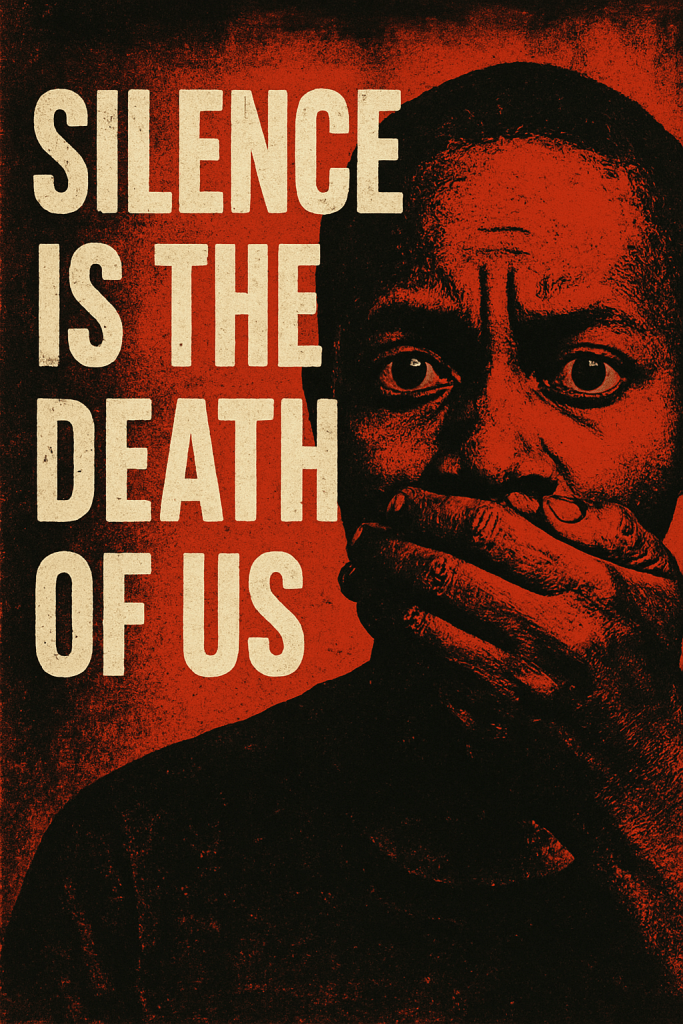
SILENCE IS THE DEATH OF US
Dear Corporate,
I know you like your linen white.
White as milk.
With no stains, no creases,
And no voices too loud or opinions too strong.
You want clean reputations,
Clean photos, clean silence.
You like me better
When I just show up, smile, hit targets,
Say “yes sir” to everything and go home.
You like me better
When I keep the fire in my belly out of your boardroom.
When I don’t question, when I don’t care too much.
But here’s what you forget,
I was me before I became your employee.
I had a voice before I had your email signature.
I had convictions before I had a clock-in code.
And I’m not about to trade all that in
For job security and polite applause.
I love justice.
The same way you love KPIs.
I care about this country,
The same way you care about brand image.
So when you see me at a protest,
Don’t flinch.
I’m not unstable.
I’m not rebellious.
I’m just awake.
When I call out corruption,
I’m not ruining your name,
I’m protecting it.
Because if systems rot,
Your success does too.
When I tweet in anger,
It’s not because I’m angry all the time.
It’s because I still believe that things can change.
That voices matter. That silence is too heavy to carry anymore.
I’m not asking for much.
Just this,
Don’t punish me for caring.
Don’t blacklist me for believing.
Don’t put me in a corner
Because I refuse to play blind.
I want to work.
I want to grow.
But I also want to live in a country where truth doesn’t cost you your job.
Let me speak.
Let me stand.
Let me protest, cry out, and still walk into your office on Monday morning with purpose.
Because fighting for what’s right
And showing up for work
Aren’t enemies.
They’re both signs I give a DAMN.
So no,
I’m not mad.
I’m not disloyal.
I’m just patriotic.
And I won’t whisper that.
Sincerely,
Still the right person for the job. Just louder.
@okelododdychitchats
Silenceisthedeathofus #Speak #PoeticJustice #Justice #Justice4AlbertOjwang #SpeakUp #Corruption #EndCorruption
When I fall in Love
When I fall in love,
there will be no trumpet,
no choir of angels rehearsing hallelujah,
just the quiet breaking of bread
between two hands that have known hunger.
I will not ask the sun to shine,
it will.
I will not beg the wind to be still
it will not.
But you,
you will laugh like sugar spilling from a jar
and I will remember
how joy can be messy
and still be beautiful.
When I fall in love,
I will not be the half of a whole,
I will be
the whole of a whole
meeting another
who does not need
completing,
only witnessing.
There will be no ticking clock,
no red thread prophecy,
no trembling knees
(unless from laughter).
I will not call it fate.
I will call it choice.
I will choose you.
And choose you again.
Even when your smile falters,
even when your breath
carries thunder.
I will not write sonnets.
I will write grocery lists
with your name at the bottom
underlined twice.
We will argue about soup.
And make up in whispers
like old songs
that only the two of us remember.
When I fall in love,
I will not promise forever.
But I will give you every now
I can carry.
I will plant soft yeses
in the soil of every day.
I will hold space
for your shadow
and your shine.
And when I say goodbye,
(if goodbye must come)
it will be with the ache
of one who has lived
and not regretted
a single soft, unspoken
I love you.
When I fall in love,
it will not be a fairy tale.
It will be
a revolution
of two
sacred, flawed,
magnificent
souls
saying,
yes, still.
And you,
you will not be worshipped.
You will be
seen.
And that, my love,
is holy enough.
@okelododdychitchats
The Sound of Love (In Three Words)
There is a river in my chest,
its current stirred by longing.
I have wrestled with syllables,
wrestled them like Jacob with the angel,
and still, they slipped from me.
I’ve summoned sonnets like old friends,
dressed up my ache in velvet metaphors,
cradled my truth in gilded rhyme,
but still, the soul was unclothed.
Words, those proud and peacock things,
marched across parchment
but none bore the weight
of my trembling heart.
Then came silence.
And out of silence,
three humble drumbeats:
I. Love. You.
They stood,
not as grand orators,
but as gospel.
Simple.
Sacred.
Enough.
@okelododdychitchats
It’s Colonial, I Swear
What happened before the roses came ?
1. Cold Showers and Pink Suits
There’s a special place in hell for cold showers and it’s probably somewhere next to the queue at the passport office. And now you want me to willfully take one, shave, powder my neck, and wear that pink suit that makes me look like a soft loan? Just to go out on a date? Bruh. That’s not love; that’s martyrdom. I did not survive Nairobi water bills to be out here moisturizing for cold balconies and cappuccino dust.
2. Love in the Time of Third Parties
Who even decided that love needs to come with an invoice and VAT? Dating in this economy feels like trying to start a business on a chama budget. You spend thousands to sit across someone in a place where both of you are silently trying to gauge who is more emotionally unavailable, while the waitress thinks you’re about to propose.
3. The Whitewashing of Romance
Let’s talk about it: is the modern date a colonial export? Imported like jazz music and instant noodles? Because, really, how did our grandfathers do it? They didn’t need a date. They needed a strong back, a hoe, and a keen eye for dowry negotiation. Now we’re out here buying roses that die in 48 hours, basically love-shaped perishables and calling it romance.
4. Introverts Anonymous
I’m not antisocial. I’m pro-solitude. There’s a difference. Why must love always be on display, like it’s a talent show and we’re all auditioning for the role of “Emotionally Available Partner ”? Me, I prefer my affection with a side of silence. Just Netflix algorithms that understand me better than most people.
5. The Psychology of Smashing vs Smiling
Some dates feel more like interrogations with ambience. You’re sitting there, trying to chew tasteless pasta gracefully while wondering if she thinks your smile means “I like you” or “I’m just horny.” You’re sweating from trying to remember if you mentioned you were raised Christian or spiritual but not religious.
6. Date Inflation & Emotional Capitalism
Who decided that love must be shown through receipts? That emotional availability must be measured by how many brunches you’ve paid for? I’ve dated women who thought the absence of fine dining was the absence of love. Hey, the pepper in my githeri is a form of affection. Don’t let capitalism gaslight your heart.
7. Domestic Love, Anyone?
Let’s stay home. I can cook, I can serve, and I can even throw in bad jokes for seasoning. No need for that performative laughter at Java. I want us barefoot in the house, arguing about how much salt I put in the food. That, my friends, is real bonding. And I can pause to pee during the movie without missing the plot or the bill.
8. Public Displays of Affection Fatigue
What’s so romantic about someone interrupting your moment to ask “would you like sparkling or still?” Let me love you in sweatpants. Let’s laugh over burnt ugali. Let’s fall asleep on opposite ends of the couch and meet halfway in a dream. That’s the kind of love that doesn’t make it to Instagram, but lasts.
9. Love Without Logistics
The planning of dates stresses me more than the dating itself. Reservations, rides, fitting into attires from 2021, it’s a full-time job. Why can’t we date like we used to play kalongo in childhood? Spontaneous, anarchic, and mostly in someone’s house with limited adult supervision.
10. Let’s Redefine Romance
So no, I’m not taking cold showers for a warm table. That doesn’t mean I love less. I just love differently. Quietly. Deeply. With less garnish and more substance. If love is a language, I speak it fluently in slippers and home-cooked meals. The balcony is cold, the city is expensive, and my pink suit is for weddings only. Choose your battles wisely. Choose your love even wiser.
@okelododdychitchats
I Know She’s Interested
There is a woman, and I know she is interested.
She does not say it, but I hear it in the way she says my name, soft, unhurried, like it belongs to her mouth. She watches, not in passing, but as if memorizing, as if tracing the edges of something she does not yet have words for.
She leans in slightly when I speak, the smallest movement, but I notice. She laughs, not loud, not demanding, but enough to let me know she is listening. Enough to make me want to be funnier, just to hear it again.
I watch her watching me, and I wonder if she knows that interest, when unspoken, is still a language. That a glance held a second too long is as heavy as a confession. That I am reading between the lines, filling in the spaces where her words should be.
She says “good night,” but I read it as “stay a little longer.”
She says “see you later,” but I hear “think of me when I’m gone.”
She says nothing at all, and still, I understand.
There is a woman, and I know she is interested.
@okelododdychitchats
She Still Wears Dirty Shoes
She was beautiful.
Not the loud kind of beautiful,
not the kind that demands attention,
but the kind that catches you off guard,
soft, steady,
like the warmth of the sun on your skin when you didn’t realize you were cold.
I admired everything about her.
The way she walked,
like she wasn’t just passing through the world,
the world was lucky she chose to walk on it.
The way she spoke,
words rolling off her tongue like they’d been waiting for her to find them,
gentle but firm,
like truth dressed in silk.
Her skin-flawless.
Not flawless like makeup ads promise,
but flawless like rivers cutting through stone,
like history written softly across her face.
Her body?
Not perfect by anyone’s rules but her own,
a shape that felt like poetry,
not the kind you study,
the kind you feel.
Her style was effortless.
Not curated,
just honest.
Clothes didn’t wear her;
she wore them,
with a grace that made simplicity look like art.
But her shoes were always dirty.
It didn’t matter if they were brand new,
straight from the box,
or worn down from years of walking,
somehow,
they were always stained with something.
Dust, mud,
Just something
And I hated that.
Not because it mattered, really,
but because I thought it should.
Maybe it was the part of me that needed order,
needed neatness,
the part that saw beauty in straight lines
and clean edges.
Her shoes didn’t fit that picture.
They kicked at the corners of my mind,
scuffed up the idea of what “perfect” should look like.
So I let her go.
Not because she wasn’t enough,
but because her shoes weren’t clean.
It sounds ridiculous now,
but at the time,
it felt like reason.
Five years passed.
Life happened,
the kind of life that leaves its own dirt behind.
Mistakes, lessons,
love gained, love lost,
all of it piling up like dust in places you forget to clean.
Then I saw her again.
Last week.
Standing there,
the same light in her eyes,
like the years hadn’t dimmed a thing.
She smiled,
the kind of smile that could stretch across oceans,
the kind that makes you feel like you’ve been missed,
even if you haven’t.
She still looked good.
Better, actually.
Like life had layered her with more stories,
more depth,
and none of it weighed her down.
Her teeth were bright,
her scent was warm,
her presence still undeniable.
And her shoes?
Still dirty.
But this time,
I didn’t care.
Because now I know,
life isn’t about spotless shoes.
It’s not about keeping clean what’s meant to get messy.
It’s about walking,
about moving,
about showing up,
even if the road leaves its mark on you.
Her shoes weren’t a flaw.
They were proof.
Proof that she’d lived,
that she’d walked through things and kept going,
that beauty isn’t about what stays clean,
it’s about what survives the dirt.
She still wears dirty shoes.
And now,
I think that’s the most beautiful thing about her.
@okelododdychitchats
 okelododdychitchats