After

It didn’t fall so much as it unfolded.
One minute, the sky was a familiar ceiling,
and the next, a bruise began to spread from the center out,
smothering the sun until the light felt thin,
brittle enough to snap between my fingers.

You don’t realize how much the light holds you up
until it’s gone.

Now, the air is thick with the soot of burned-out stars.
The iron draft of a closing door has changed everything,
it’s a predatory thing.
It’s in my bones now, pulling my shoulders toward the dirt,
turning my footsteps into heavy prayers that no one hears.
My knees have forgotten the habit of standing.

There is a cold, dense knot where my chest used to be,
a collapsed star, a private black hole
feeding on the scraps of my better days.
It doesn’t just take, it erases.
It has swallowed the before, the maybe, and the us,
leaving only this heavy, crippled silence
where my heart used to beat.

@doddyokelo

Rivers of My Own Making


There is no universe in which I am sitting down to read how someone built a whole cereal shop from a single grain of rice. Never. I respect the effort it took to type all that optimism, but no. Your road doesn’t bend like mine, and I refuse to be shamed into feeling inadequate simply because my idea of joy moves to a different sun. If you want to pray, pray. I pray too, my brother. We are all sinners anyway. The only difference is how we manage our sins. Mine are personal. I enjoy them quietly and carry the consequences alone. Yours arrive with collateral damage, cloaked in lies, dipped in theft, and sanctified from the pulpit. A pastor from hell, if we’re being honest. Cut me some slack, man.

2025 has been incredible. Financially, the fireworks stayed away, but the lessons arrived on time. Lessons that stay. I learned how to take care of myself by leaning into what I love. I learned that some opinions bloom like flowers but are made of dust, pretty to see, hollow to hold. I learned the strength that lives in subtle sighs, the subtle mastery in watching without interference, the rare discipline of letting words fall around me without reaching for a reply. And perhaps the hardest lesson of all. When the lights dim, the applause fades, and the crowd vanishes into the night, only your own shadow remains. That truth seeps in like a silent river, carrying its weight with quiet insistence, tracing the contours of the soul, unseen yet unstoppable, leaving freedom in its wake.

I carry no resolutions scribbled on paper for 2026. Free of banners of ambition and untouched by public drumbeats, I carry instead intentions. I plan to be better. To build myself financially. To chase what I want without hesitation or apology. And yes, I plan to cut people off, gently but firmly, when their presence drains more than it gains. Whether I leave or stay, your life will continue uninterrupted. I’ve made peace with that long ago. I plan to do more business, take bolder risks, and travel wider, seeing places for their stories, feeling the streets beneath my feet, tasting lives outside my own. Unfettered by heralded plans, letting the quiet flowering of my journey reveal its own story.

Still, gratitude stays. Deeply. For the hands that steadied me when my footing slipped. For those who pulled me out of trenches without demanding explanations. For those who trusted my strength enough to place opportunity in my hands. For that, a special medal goes to Sheila Chepkirui Yegon. Some people are mere passing notes in your life, others are chords that resonate. Sheila is a river of melodies, a living network that carries you forward, flowing steady, connecting what was, what is, and what could be. May God widen her path and multiply her grace.

And always, my brother Stephen Ochieng (Soo Ochieng), take your flowers, bana. Always. We remain stubborn believers in the impossible, still dreaming with the audacity of people who refuse to shrink their visions too early.

This isn’t a storm, it’s alignment,
It’s growth,
It’s choosing your lane, and driving without explaining the route.

Solo Drive

I’ve marked no map with ink or public pride,
To show the woods where I intend to go.
The things I seek have nowhere left to hide,
And what I reap is what I choose to sow.
I take the path where fewer shadows bide,
And leave the crowds to talk of what they know.
The fence I mend is built of quiet stone,
To keep the peace and part the draining guest.
A man can walk a standard mile alone,
And find in silence all he needs of rest.
For every seed of will that I have grown,
I ask no leave to put it to the test.
So let the wheels engage their rhythmic song,
Across the hills and through the turning lane.
I owe no word to prove where I belong,
Or why I chose the sun above the rain.
The drive is short, the inner light is strong,
I go my way, and need not explain.

@doddyokelo

Monday, But Why ?

I am tired,
shrunken, chilled, and worn at the cuffs of my soul.
The night itself, a careless laundress,
folded me wrong and ironed in the creases of a bad mood.

My thoughts are heavy, they are a parade of strangers
wearing wet wool coats, stomping through the hallways of my mind.
And my intellect is bald, yes, but worse,
a barren, frozen tundra where not a single rebellious idea
has the audacity to sprout.

It is Monday.
the same old cracked vinyl of a gloomy chorus,
stuck, skipping, repeating the universal dullness.
My strength is a barometer at zero,
my motivation a phone on airplane mode.

This is the taste of it,
Monday, served on a cold porcelain plate.
Bitter at the edges, bland and beige in the middle,
a main course of immediate responsibilities.

But really,
why must Monday always show up like a guest who never takes the hint to leave?

@doddyokelo

Daughter of The Mountain

I met her on an afternoon
when the sun burned low,
spilling gold across the earth
as though the day itself leaned close
to let slip its quiet confessions.

She was slim-thick,
a flame held steady in the wind,
with a presence that filled the space
more surely than height or breadth could command.
Her skin bore the quiet radiance
of fertile Kenyan earth after rain,
luminous, alive with the memory of rivers.

Her beauty was the beauty that stays,
like a song remembered long
after the singer has gone.
Her eyes were wide, dark pools,
holding the innocence of unspoken dreams,
and the fierce pride of the hills,
green and ancient,
keepers of stories older than memory.
When she looked, it was not merely at you,
it was into you,
as though the soul were something
she had always known,
and only sought to confirm.

Her laughter was small, quick,
yet it carried,
like the delicate chiming of cowbells
drifting from a far valley.
Her movements, precise, almost shy,
the way a swallow folds its wings before flight,
yet within them was a grace
no stage could rehearse.

She was not made of ornaments or excess
but of silences,
of natural songs,
of that soft balance between fragility
and unyielding strength.

To call her beautiful
would be to simplify what was infinitely complex.
She was the outline of twilight
against the ridge,
the fragrance of tea leaves
crushed between fingers,
the silence of evening rain on tin roofs.
She was the Mountain itself,
its promise, its mystery,
its unbroken spirit made flesh.

And in her presence,
I felt the world pause,
as though even time leaned in
to watch her pass.

@doddyokelo

Crunchy Honest Chips

I was born just outside my father’s home. I mean outside the fence. Not in a hospital. Not in some sterile maternity ward with nurses who smell like Dettol and sigh through masks. No. I came into this world the traditional way, on ancestral soil, barefoot and bold, like a true son of Asembo. My grandmother delivered me. I’ve said this before, and I’ll say it until my tongue is weary, it’s something to be proud of. It’s raw. It’s traditional. And I guess, so am I.

Asembo is about 15 minutes away from Raila’s Opoda Farm. But this is not about him. This is about home. Or the idea of it. Because although I was born there, I didn’t grow up there. In fact, it took me seventeen years to return. And when I finally did, with the awkward gait of a visitor in his own past, I found our home was no longer a home. It had become a farm.

The only proof we were ever there are the graves—traces of my father, my uncle, my grandmother, and my grandfather. The cement doesn’t crack. It holds secrets. They told me the land is mine now. Or at least part of it. My father was the last born, and in our traditions, that means the home was his. By extension, now mine. But what do you do with a piece of land full of ghosts?

There’s another parcel—12 acres or so. I didn’t earn it. Didn’t break my back for it. Didn’t argue with chiefs or attend land tribunal hearings in stuffy rooms with men who say “utu ni utu” before betraying you for a bribe. It was passed to me like a baton in a relay. A gift from the dead. So no, I’m not bragging. And even if I was, who really wants to sweat for something they can get for free? This is Kenya, after all. We queue for handouts and call it luck.

I grew up in bits and pieces—Homa Bay, Kisumu, Rongo. Like a nomad in search of permanence. In 2007, my mother built a modest house in Rongo. That’s home now. We live there with strangers who’ve since become family, the kind you don’t choose but grow into like an oversized sweater that slowly starts to fit. In Rongo and almost everywhere else in Luo Nyanza, people intermarry—Luos, Luhyas, Kisiis. But not Kikuyus. No, Kikuyus are where the line is drawn.

Luos hate Kikuyus and Kikuyus hate Luos. That’s the story we were handed by the colonialists—wrapped in propaganda and sprinkled with enough suspicion to last generations. Divide and rule. And rule they did. Now we inherit the hate like old family furniture we’re too proud to throw out. We say things like: “A Luo is a witch with a sack of rituals on his back” or “A Kikuyu is greedy and selfish” or that “Kikuyu women kill their husbands.” What is that? That’s not wisdom. That’s premium-grade poetic cow dung.

Ask anyone for proof, and they’ll stutter like a bad radio signal.

I don’t believe in what I haven’t seen. I won’t condemn a whole tribe because Otieno once borrowed your charger and never returned it. Or because Wanjiku blocked you on WhatsApp after you bought her chips kuku.

If that makes me fallacious, then call me a walking fallacy.

And listen, Kikuyu women are beautiful. Not the stereotypical light-skinned, big-chested, flat-behind and thin legs that don’t  match the body types, those that your uncles warned you about. No. These days, they come in thick—size sevens with curves that look like they were negotiated in parliament. Faces sculpted like the gods used cheekbones as currency. And thighs, God help us, thighs the colour of roasted cashews—thighs that can save entire nations.

I’m dating one. A Kikuyu. Six years now, give or take a few breaks that almost broke us. Her name is Koi, but if you know her like I do, you call her Spiky. And Spiky? Spiky is divine.

Spiky is what you’d get if elegance had a baby with audacity. She walks like confidence and still laughs like she was raised by love. Her skin is caramel dipped in honey, the kind that makes you wonder if sunlight took lessons from her. Her smile is a gospel that can turn a hard man soft. She’s smart, too. Smart with the kind of intelligence that knows when to speak, when to keep quiet, and when to look at you in a way that makes you question all your life choices.

Her body is poetry. The kind of body that makes you want to write odes in traffic. Her mind is a map. Her heart is a home I keep returning to. Even when I say I’m done.

I am not here to convert you. I am just here to say—love is not tribal. Neither is beauty. Neither is home.

Some of us were just born outside, by grandmothers with hands strong enough to deliver a future.

And maybe that’s enough.

It was 2AM or thereabouts. You know that hour that’s neither here nor there—when the silence feels staged, like the night is watching you back. I wasn’t asleep, of course. My insomnia is back. It always returns like an old lover who doesn’t knock, just walks in and makes itself comfortable.

Spiky was up too, prepping for one of her strange shifts. She works those ungodly hours, where your body wants to rest, but capitalism wants a report submitted by 5:45AM. I decided to keep her company, texting back and forth. In the middle of our banter—whose contents I won’t get into, partly because I’m lazy and partly because it might send you off on a tangent—we veered into a detour.

There’s a Mugithi na Ndumo at Red Room from 2PM,” she texted. “Come with me?”

Mugithi is a Kikuyu genre—think of it as country music that drank a full bottle of Muratina and decided to wear a hat. Ndumo is the dance—the erratic, shoulder-driven, hip-twisting rhythmic warfare. It’s like watching a fight that no one wants to break up. I don’t speak Kikuyu. I know only “mbesha shigana?” which loosely translates to “how much money are we wasting here?” But I said yes. Because love is also showing up where you don’t belong and hoping the rhythm saves you.

Google Maps says Red Room is in Kilimani. Technically true. It’s on Adlife Plaza. But if you follow those blue dots on Google blindly, you’ll find yourself in West Pokot or emotionally lost. Take my advice: get to Yaya Centre, take that left turn. Adlife Plaza is a few blocks in, across from Shujah Mall. Red Room lives on the first floor.

The place is cool.  Genuinely cool. It’s shaped like an L, as if someone folded the club and forgot to unfold it. The counter sits at the center like a bartender god. There’s a stage—clean, slightly elevated, and a DJ booth carved with intention, not just dumped there. The seats in the regular area are metallic, but not the koroga kind. These ones have cushions that hold your secrets. They are comfortable. The VIP area, of course, has better seats—those white kinyozi-waiting-area chairs, only here they’ve been baptized and saved.

The roof is translucent, high enough not to threaten your dignity, and there’s space to dance without knocking a stranger’s elbow. The floor is plastic turf. That fake grass that doesn’t pretend to be real anymore. The kind you’d find in a cool rooftop bar, or a child’s playground where no one gets hurt when they fall—except emotionally.

Our waiter is polite. Genuine. The kind that makes you want to tip even when you’re broke. We order goat meat and chips not fries. I refuse to gentrify potatoes. Spiky, glowing like the first sip of good wine, is in wide-legged purple pants stitched by a fundi who understands women. Her top—a crocheted piece of African fabric art—is from the same fundi. She looks like Nairobi confidence dressed in culture. I’m in wide-legged pants too (no judgment), a free shirt I got from Dura Poa and my trusted white Converse. I order a litre of Muratina because, well, when in Rome… get tipsy on their traditions.

Spiky orders two bottles of Kenya Originals.

The food comes and we eat because what else do you do when food comes? Their meat is soft. Tender like it was raised by a grandmother with a kind voice. The chips are golden and crunchy—honest chips, not those oily, sad ones that taste like heartbreak.

Then comes Gasheni. She wasn’t on the lineup, just a curtain raiser. But sometimes curtain raisers leave you wondering why the main act even bothered. She did well. She cleared the path like John the Baptist. And when DJ Dibull came on, he walked through like the Messiah of sound. He played magic. I danced. I didn’t understand a single lyric but my body understood the beat, and sometimes, that’s all that matters.

Tony Young came in next. One hour and thirty minutes of pure Kikuyu Vaibu. By the time Waithaka Wa Jane got on stage, I think the crowd was tired. Or maybe he was just too mellow for 11PM energy.

Ah, I almost forgot—DJ 44. That man spins like he’s in love with every beat. Like each song owes him rent.

At our table, a couple and a lady joined us. Later, a guy.   All of them were vibes. They figured out pretty quickly that I wasn’t Kikuyu—maybe it was the way I danced, like someone dodging potholes. But they embraced me. One of them told me, “If you can’t beat us, join us.”

So I did.

And I’ve invited them to the Luo Festival on the 9th of August. There, I’ll beat them. And they’ll join me. And we’ll call it unity.

Mugithi was greatness. Pure, fermented, cultural greatness. The kind that reminds you that sometimes all it takes is a beat for you to remember how good it feels to just live.

Thank you for this Spiky. I loved it Baby!

@okelododdychitchats

AND YET, WE VOTE

WHO PROTECTS THE PEOPLE FROM THE POLICE ?


You may write us off,
dismiss us ,
ignore us in Parliament halls padded with stolen wealth,
but still, we see

We are the country beneath your motorcades,
the hands that build and break,
the voices cracking in the dust
because hope costs too much now.

And yet,
we vote.

We vote for thieves in clean suits

We vote for wolves draped in our flags,

Enough.

We are tired.
Tired of job descriptions reading “Must be connected.”
Tired of degrees gathering dust
while our dreams starve in silence.

We are tired of joblessness turned into weaponry,
young men hired cheap to kill our own voices,
paid to break bones they’ve never healed in their own lives.

Tired of watching peaceful protesters
shot dead,
while those who loot in daylight
are guarded like royalty.

Tired of asking:
“Who protects the people from the police?”

Tired of staged outrage,
press conferences filled with air,
and politicians who only remember their roots
when it’s time to lie again.

You fight for positions, not for people.
You dine with the devil,
then kneel in churches too small for your sins.

You debate your egos on live TV
as our people dig trenches
not for roads,
but for graves.

You die to be seen.
But we die because we’re ignored.

Kenya is choking.
On debt.
On lies.
On the stink of promises unkept.

We are not asking.
We are telling.

This time, we vote with memory.
With pain.
With names.
With tears that learned how to speak.

This time,
you will not scare us with teargas.
You will not buy us with t-shirts.
You will not distract us with empty tribal drums.

We will remember who was silent when we bled.
We will remember who smiled while we starved.
We will remember who disappeared our brothers
and called us TREASONOUS CRIMINALS.

We are not the children you once fooled.
We have grown teeth.
We have grown rage.
And we are coming.

So let the ballot tremble.
Let your seats shake.
Let the ground beneath your stolen homes shift.

Because next time,
we are not just voting.

We are reclaiming.

And if you still don’t listen,
then hear this:

We are not afraid.
We are not asleep.
We are not yours.
Not anymore.

@Okelododdychitchats


#RUTOMUSTGO #ENDPOLICEBRUTALITY #RAGEANDCOURAGE
#JUSTICEFORELIJOSHUA

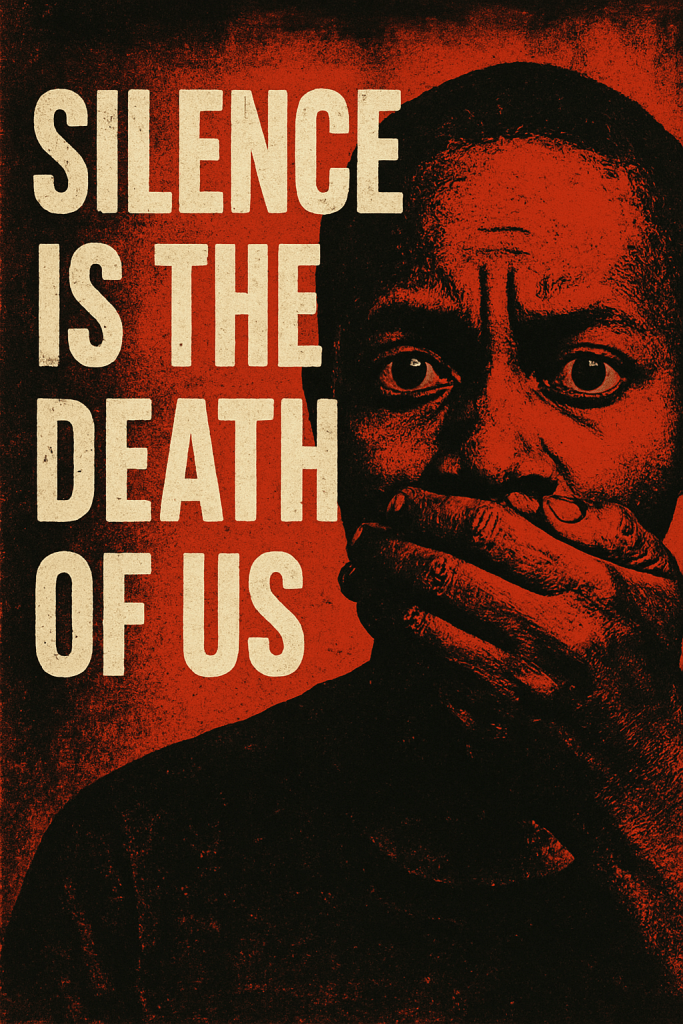
SILENCE IS THE DEATH OF US

Dear Corporate,

I know you like your linen white.
White as milk.
With no stains, no creases,
And no voices too loud or opinions too strong.
You want clean reputations,
Clean photos, clean silence.

You like me better
When I just show up, smile, hit targets,
Say “yes sir” to everything and go home.
You like me better
When I keep the fire in my belly out of your boardroom.
When I don’t question, when I don’t care too much.

But here’s what you forget,

I was me before I became your employee.
I had a voice before I had your email signature.
I had convictions before I had a clock-in code.
And I’m not about to trade all that in
For job security and polite applause.

I love justice.
The same way you love KPIs.
I care about this country,
The same way you care about brand image.

So when you see me at a protest,
Don’t flinch.
I’m not unstable.
I’m not rebellious.
I’m just awake.

When I call out corruption,
I’m not ruining your name,
I’m protecting it.
Because if systems rot,
Your success does too.

When I tweet in anger,
It’s not because I’m angry all the time.
It’s because I still believe that things can change.
That voices matter. That silence is too heavy to carry anymore.

I’m not asking for much.

Just this,
Don’t punish me for caring.
Don’t blacklist me for believing.
Don’t put me in a corner
Because I refuse to play blind.

I want to work.
I want to grow.
But I also want to live in a country where truth doesn’t cost you your job.

Let me speak.
Let me stand.
Let me protest, cry out, and still walk into your office on Monday morning with purpose.
Because fighting for what’s right
And showing up for work
Aren’t enemies.
They’re both signs I give a DAMN.

So no,
I’m not mad.
I’m not disloyal.
I’m just patriotic.
And I won’t whisper that.

Sincerely,
Still the right person for the job. Just louder.

@okelododdychitchats

Silenceisthedeathofus #Speak #PoeticJustice #Justice #Justice4AlbertOjwang #SpeakUp #Corruption #EndCorruption

Tukutendereza Yesu

State House Road smells fresh, like the air has been scrubbed clean. The rain came down hard, soaking everything in sight, and now I’m walking past YMCA Central, taking it all in. Two holes sit dangerously by the roadside, barely covered with small tree branches – useless at stopping anything from falling in.

It’s still drizzling, but the world feels different. The water in the trenches flows peacefully, no trash clogging it up. The road is strangely clean, almost surreal, but the traffic toward University Way is as crazy as ever. Amid the noise, I can hear people singing. The voices are gentle, calming, carrying the unmistakable melody of an SDA hymn. “Blessed Assurance, Jesus is Mine” floats around me, a song I know will stay in my head long after it fades-just like “Tukutendereza Yesu” always does.

The drizzle is cool against my skin, I can feel gentle drops of water kissing it. It’s almost refreshing, but I’m freezing. I thought I was smart leaving my jacket at home, it would have ruined my look, but now I’m regretting it. Style is one thing, warmth is another. Today, “freeze and shine” is a reality. Style will kill me !

When I get to the bus stop, what we call Stage here in Kenya, I’m lucky enough to find a matatu right away. I climb in and grab a seat at the back, but there’s a random remote sitting there. For a second, I wonder if that’s why the seat was empty. Maybe it belongs to the woman next to me? Turns out, it’s the matatu’s remote. I pick it up, planning to hand it to the makanga when he comes for the fare. 

Finally, I’m warm again, but I’m so tired. My mind feels heavy, and I just want to get home. Looking out the window, I remember it’s Christmas season. But, something feels off. The streets are still crowded, kwani watu hawajaenda ushago hii Christmas!  The shops aren’t decorated like they usually are for Christmas, nothing like the usual festive look we’re used to – no green, no gold, no red. The waiters, shop and supermarket attendants aren’t wearing those red and white Santa hats. Has Christmas lost its magic, or is it just me?

We reach my stage (yes, that’s the bus stop again), and I step out. The drizzle hasn’t let up, and it’s still cold. I pull my scarf tighter and rush home, I just want to escape this cold. 

That’s all for now. Stay warm out there!

Wait a minute, “makanga” is tout. As I warm up at home, I’m going to play “Tukutendereza Yesu!” It always reminds me of my dad, and I love it just as much as I love my dad.

Adios !

@okelododdychitchats

Golden Hue

My skin drips cocoa butter, 
rich and unparalleled, 
like the earth holding stories of rain and sun, 
like a promise whispered by the night. 
It’s dark and beautiful, 
mysterious as a velvet sky laced with stars, 
It tells a story of history. 

It doesn’t glare or dull,
it balances like a seashell 
cupped by moonlight, 
a perfection gleaming in the sun, 
catching light like a secret revealed. 
This is my skin, 
a story of generations, 
a mark of resilience passed down with pride. 

Its scent is Yara cologne, 
layered and lingering, 
a melody made tangible, 
a fragrance infused with culture, 
with memory, with home. 
Every breath of it recalls 
the places, the hands, the voices 
that shaped me. 

Above it rests a crown, 
soft coils and curls that stretch toward the sky. 
Hair that defies gravity yet welcomes touch, 
a crown sculpted by no one but me, 
alive in its strength, its freedom, 
a hymn of self-love in every strand. 

This essence of me,
is seen and felt
it’s carried, 
it’s lived. 
Every inch speaks 
in a language only I can translate, 
a declaration of identity, 
a love letter to the self. 

So let my skin drip cocoa butter, 
let it shine unapologetically. 
Let it sing of power and joy, 
of beauty that doesn’t ask for permission. 
This darkness isn’t a void, it’s fullness, 
it’s richness, it’s light wrapped in shadow. 

Let it carry the rhythm of culture, 
the heartbeat of diversity. 
In its depth is strength, 
in its texture, truth. 
It doesn’t hide, 
it never will. 
My skin drips cocoa butter, 
and in it lies the whole world.

@okelododdychitchats

Holy Hypocrisy

Why did I stop going to church? One of the funniest reasons I’ve heard is, “My pastor was crippled and healing cripples. Like, why not heal yourself?” It’s a dark statement, but I get where they’re coming from. Let’s be honest, are these people God’s messengers or money makers in Poverty Pulpits ?

I believe in God, but I have a million questions. My friend and colleague, Evans Asudi challenges me every time we have a discussion about religion and the existence of God, he argues that the design of the universe, nature, and everything in it must have an origin. My question is, is that origin the God of the Christian Bible, Allah of the Muslim Quran, or the supernatural forces in Buddhist texts like the Tripitaka? I’m not saying these religions worship entirely different gods. They argue as if they do, but interestingly, they all seem to agree on the same devil. Crazy, right? Anyway, I believe in God and identify as Christian, but I rarely go to church. I have my reasons !

As a kid, I always questioned my existence, and while that hasn’t changed, I now find myself questioning the origins of religion. Who created it, and what was it really meant to achieve? History shows how religion has been used to create divisions, often for political gain, and it still happens today. Different religions hold varying beliefs, and even within Christianity, denominations clash. Paul even addressed this in Corinthians, questioning why Christians were divided when they were all baptized in Christ’s name. These divisions are often exploited for political purposes, given the strong influence religion has on society and politics.

I was raised in a strict Christian background where questioning the church or its leaders was off-limits. It was considered disrespectful and even thought to bring curses. Looking back, I laugh at how much I used to fear that. But, even as a kid, I could see pastors giving in to “earthly” temptations, sins they were never held accountable for. They seemed untouchable, immune to any form of criticism. Over time, this made me start questioning things more deeply, and now it’s part of why I find it difficult to step inside just any church today.

To make sense of where we are, let’s start with the history of Christianity. It began in the 1st century after Jesus’ death as a Judaic sect with some Hellenistic influences. The Catholic Church claims to be the original, with the first church said to be in Jerusalem. Over time, Christianity branched into several groups like the Church of the East, Oriental Orthodoxy, Eastern Orthodoxy, Roman Catholicism, Protestantism, and Restorationism.

In its early days, the traditional churches built schools, hospitals, and provided services that genuinely benefited the community. They did this without exploiting their congregants. But as time went on, evangelical churches started popping up what one of my great of all time writer, Chimamanda Ngozi Adichie calls “mushroom churches” in her book “Purple Hibiscus”. I’m not generalizing all evangelical churches, but many sprouted after the colonial period, often without any regulation, and some have become quite problematic.

These churches often target vulnerable people, especially our mothers. With this, sometimes, I tend to believe that the colonialists had a plan,  schools for the children, prisons for the fathers, and churches for the mothers. Anyway, that’s just a detour, let’s get back on track…A lot of these churches manipulate their followers, brainwashing them into accepting whatever the pastor says without question while reasoning that questioning will lead to the unthinkable,absurd! When pastors claim that questioning them will lead to whatever, it’s really just a way to manipulate their followers. You don’t fail or fall by speaking up or seeking answers for God’s sake !

Times without number, I’ve also heard pastors glorify poverty, insisting that wealth distances you from God, they say that having money makes you less inclined to pray. These same pastors live in luxury, strikingly paradoxical ! Some even discourage their followers from seeking medical help, claiming that doing so demonstrates a lack of faith in God, despite the Bible stating, “faith without action  is dead.” Are they referring to something who’s content they do not understand or did it change overnight ?

It’s ironic how these extreme churches often have the largest followings. And what really frustrates me is the constant fundraising, with no transparency on where the money goes. I’m tired of seeing congregants grow poorer while pastors grow wealthier. Churches should be shaping and speaking up for the community, but many stay silent when it doesn’t affect them…I am just sick and tired of this top tier deception, emotional control, psychological tactics, coercion, gas lighting, name it all! let me take a break! One day, we’ll go deeper into this, especially on how pastors are now called “Daddy” and their wives “Mummy.”

@okelododdychitchats