
I saw her again,
the girl I once loved.
Time had touched her kindly.
She wore a white dress, soft as a prayer,
and it clung to her form
like the wind belongs to the sea.
She was lovelier than I remembered,
not just in face,
but in the quiet grace she carried.
Clean. Still.
Like a page I might’ve turned too soon.
The dress, white as chapel vows,
did justice to every curve,
each one a line in the poem I once left unfinished.
She smiled,
not bitter, not bold, just enough
to stir something old in me.
She said I looked different too,
more like the man she always pictured beside her.
Stronger, quieter, maybe even kinder.
And for a moment,
in the gentle silence between us,
I think we both wondered,
not with regret,
but with a wistful sort of hope,
if the pages we wrote apart
could still make sense together.
@okelododdychitchats
Tag: blog
I Miss You More
I feel it everywhere.
In the quiet moments,
in the places you used to sit,
in the way the air feels a little heavier
without your presence in it.
There’s a space,
not loud or dramatic,
just a soft kind of empty
that follows me around.
I try to fill it with noise,
with work, with words,
but nothing really fits.
Because it’s you that’s missing.
I don’t just miss you in the big ways,
I miss the small things too.
The glance. The laugh. The comfort.
And somehow,
I just keep missing you more.
@okelododdychitchats
Crunchy Honest Chips
I was born just outside my father’s home. I mean outside the fence. Not in a hospital. Not in some sterile maternity ward with nurses who smell like Dettol and sigh through masks. No. I came into this world the traditional way, on ancestral soil, barefoot and bold, like a true son of Asembo. My grandmother delivered me. I’ve said this before, and I’ll say it until my tongue is weary, it’s something to be proud of. It’s raw. It’s traditional. And I guess, so am I.
Asembo is about 15 minutes away from Raila’s Opoda Farm. But this is not about him. This is about home. Or the idea of it. Because although I was born there, I didn’t grow up there. In fact, it took me seventeen years to return. And when I finally did, with the awkward gait of a visitor in his own past, I found our home was no longer a home. It had become a farm.
The only proof we were ever there are the graves—traces of my father, my uncle, my grandmother, and my grandfather. The cement doesn’t crack. It holds secrets. They told me the land is mine now. Or at least part of it. My father was the last born, and in our traditions, that means the home was his. By extension, now mine. But what do you do with a piece of land full of ghosts?
There’s another parcel—12 acres or so. I didn’t earn it. Didn’t break my back for it. Didn’t argue with chiefs or attend land tribunal hearings in stuffy rooms with men who say “utu ni utu” before betraying you for a bribe. It was passed to me like a baton in a relay. A gift from the dead. So no, I’m not bragging. And even if I was, who really wants to sweat for something they can get for free? This is Kenya, after all. We queue for handouts and call it luck.
I grew up in bits and pieces—Homa Bay, Kisumu, Rongo. Like a nomad in search of permanence. In 2007, my mother built a modest house in Rongo. That’s home now. We live there with strangers who’ve since become family, the kind you don’t choose but grow into like an oversized sweater that slowly starts to fit. In Rongo and almost everywhere else in Luo Nyanza, people intermarry—Luos, Luhyas, Kisiis. But not Kikuyus. No, Kikuyus are where the line is drawn.
Luos hate Kikuyus and Kikuyus hate Luos. That’s the story we were handed by the colonialists—wrapped in propaganda and sprinkled with enough suspicion to last generations. Divide and rule. And rule they did. Now we inherit the hate like old family furniture we’re too proud to throw out. We say things like: “A Luo is a witch with a sack of rituals on his back” or “A Kikuyu is greedy and selfish” or that “Kikuyu women kill their husbands.” What is that? That’s not wisdom. That’s premium-grade poetic cow dung.
Ask anyone for proof, and they’ll stutter like a bad radio signal.
I don’t believe in what I haven’t seen. I won’t condemn a whole tribe because Otieno once borrowed your charger and never returned it. Or because Wanjiku blocked you on WhatsApp after you bought her chips kuku.
If that makes me fallacious, then call me a walking fallacy.
And listen, Kikuyu women are beautiful. Not the stereotypical light-skinned, big-chested, flat-behind and thin legs that don’t match the body types, those that your uncles warned you about. No. These days, they come in thick—size sevens with curves that look like they were negotiated in parliament. Faces sculpted like the gods used cheekbones as currency. And thighs, God help us, thighs the colour of roasted cashews—thighs that can save entire nations.
I’m dating one. A Kikuyu. Six years now, give or take a few breaks that almost broke us. Her name is Koi, but if you know her like I do, you call her Spiky. And Spiky? Spiky is divine.
Spiky is what you’d get if elegance had a baby with audacity. She walks like confidence and still laughs like she was raised by love. Her skin is caramel dipped in honey, the kind that makes you wonder if sunlight took lessons from her. Her smile is a gospel that can turn a hard man soft. She’s smart, too. Smart with the kind of intelligence that knows when to speak, when to keep quiet, and when to look at you in a way that makes you question all your life choices.
Her body is poetry. The kind of body that makes you want to write odes in traffic. Her mind is a map. Her heart is a home I keep returning to. Even when I say I’m done.
I am not here to convert you. I am just here to say—love is not tribal. Neither is beauty. Neither is home.
Some of us were just born outside, by grandmothers with hands strong enough to deliver a future.
And maybe that’s enough.
It was 2AM or thereabouts. You know that hour that’s neither here nor there—when the silence feels staged, like the night is watching you back. I wasn’t asleep, of course. My insomnia is back. It always returns like an old lover who doesn’t knock, just walks in and makes itself comfortable.
Spiky was up too, prepping for one of her strange shifts. She works those ungodly hours, where your body wants to rest, but capitalism wants a report submitted by 5:45AM. I decided to keep her company, texting back and forth. In the middle of our banter—whose contents I won’t get into, partly because I’m lazy and partly because it might send you off on a tangent—we veered into a detour.
“There’s a Mugithi na Ndumo at Red Room from 2PM,” she texted. “Come with me?”
Mugithi is a Kikuyu genre—think of it as country music that drank a full bottle of Muratina and decided to wear a hat. Ndumo is the dance—the erratic, shoulder-driven, hip-twisting rhythmic warfare. It’s like watching a fight that no one wants to break up. I don’t speak Kikuyu. I know only “mbesha shigana?” which loosely translates to “how much money are we wasting here?” But I said yes. Because love is also showing up where you don’t belong and hoping the rhythm saves you.
Google Maps says Red Room is in Kilimani. Technically true. It’s on Adlife Plaza. But if you follow those blue dots on Google blindly, you’ll find yourself in West Pokot or emotionally lost. Take my advice: get to Yaya Centre, take that left turn. Adlife Plaza is a few blocks in, across from Shujah Mall. Red Room lives on the first floor.
The place is cool. Genuinely cool. It’s shaped like an L, as if someone folded the club and forgot to unfold it. The counter sits at the center like a bartender god. There’s a stage—clean, slightly elevated, and a DJ booth carved with intention, not just dumped there. The seats in the regular area are metallic, but not the koroga kind. These ones have cushions that hold your secrets. They are comfortable. The VIP area, of course, has better seats—those white kinyozi-waiting-area chairs, only here they’ve been baptized and saved.
The roof is translucent, high enough not to threaten your dignity, and there’s space to dance without knocking a stranger’s elbow. The floor is plastic turf. That fake grass that doesn’t pretend to be real anymore. The kind you’d find in a cool rooftop bar, or a child’s playground where no one gets hurt when they fall—except emotionally.
Our waiter is polite. Genuine. The kind that makes you want to tip even when you’re broke. We order goat meat and chips not fries. I refuse to gentrify potatoes. Spiky, glowing like the first sip of good wine, is in wide-legged purple pants stitched by a fundi who understands women. Her top—a crocheted piece of African fabric art—is from the same fundi. She looks like Nairobi confidence dressed in culture. I’m in wide-legged pants too (no judgment), a free shirt I got from Dura Poa and my trusted white Converse. I order a litre of Muratina because, well, when in Rome… get tipsy on their traditions.
Spiky orders two bottles of Kenya Originals.
The food comes and we eat because what else do you do when food comes? Their meat is soft. Tender like it was raised by a grandmother with a kind voice. The chips are golden and crunchy—honest chips, not those oily, sad ones that taste like heartbreak.
Then comes Gasheni. She wasn’t on the lineup, just a curtain raiser. But sometimes curtain raisers leave you wondering why the main act even bothered. She did well. She cleared the path like John the Baptist. And when DJ Dibull came on, he walked through like the Messiah of sound. He played magic. I danced. I didn’t understand a single lyric but my body understood the beat, and sometimes, that’s all that matters.
Tony Young came in next. One hour and thirty minutes of pure Kikuyu Vaibu. By the time Waithaka Wa Jane got on stage, I think the crowd was tired. Or maybe he was just too mellow for 11PM energy.
Ah, I almost forgot—DJ 44. That man spins like he’s in love with every beat. Like each song owes him rent.
At our table, a couple and a lady joined us. Later, a guy. All of them were vibes. They figured out pretty quickly that I wasn’t Kikuyu—maybe it was the way I danced, like someone dodging potholes. But they embraced me. One of them told me, “If you can’t beat us, join us.”
So I did.
And I’ve invited them to the Luo Festival on the 9th of August. There, I’ll beat them. And they’ll join me. And we’ll call it unity.
Mugithi was greatness. Pure, fermented, cultural greatness. The kind that reminds you that sometimes all it takes is a beat for you to remember how good it feels to just live.
Thank you for this Spiky. I loved it Baby!
@okelododdychitchats
AND YET, WE VOTE
WHO PROTECTS THE PEOPLE FROM THE POLICE ?
You may write us off,
dismiss us ,
ignore us in Parliament halls padded with stolen wealth,
but still, we see
We are the country beneath your motorcades,
the hands that build and break,
the voices cracking in the dust
because hope costs too much now.
And yet,
we vote.
We vote for thieves in clean suits
We vote for wolves draped in our flags,
Enough.
We are tired.
Tired of job descriptions reading “Must be connected.”
Tired of degrees gathering dust
while our dreams starve in silence.
We are tired of joblessness turned into weaponry,
young men hired cheap to kill our own voices,
paid to break bones they’ve never healed in their own lives.
Tired of watching peaceful protesters
shot dead,
while those who loot in daylight
are guarded like royalty.
Tired of asking:
“Who protects the people from the police?”
Tired of staged outrage,
press conferences filled with air,
and politicians who only remember their roots
when it’s time to lie again.
You fight for positions, not for people.
You dine with the devil,
then kneel in churches too small for your sins.
You debate your egos on live TV
as our people dig trenches
not for roads,
but for graves.
You die to be seen.
But we die because we’re ignored.
Kenya is choking.
On debt.
On lies.
On the stink of promises unkept.
We are not asking.
We are telling.
This time, we vote with memory.
With pain.
With names.
With tears that learned how to speak.
This time,
you will not scare us with teargas.
You will not buy us with t-shirts.
You will not distract us with empty tribal drums.
We will remember who was silent when we bled.
We will remember who smiled while we starved.
We will remember who disappeared our brothers
and called us TREASONOUS CRIMINALS.
We are not the children you once fooled.
We have grown teeth.
We have grown rage.
And we are coming.
So let the ballot tremble.
Let your seats shake.
Let the ground beneath your stolen homes shift.
Because next time,
we are not just voting.
We are reclaiming.
And if you still don’t listen,
then hear this:
We are not afraid.
We are not asleep.
We are not yours.
Not anymore.
@Okelododdychitchats
#RUTOMUSTGO #ENDPOLICEBRUTALITY #RAGEANDCOURAGE
#JUSTICEFORELIJOSHUA
To You, Tonight
You say you don’t read much.
But somehow, you always read me.
And maybe, without knowing,
You taught me how to bleed through the pen,
To shape silence into syllables,
To hold space for feeling,
Even when the world is loud.
So tonight,
As night settles in a robe of velvet quiet,
I write not to ask, nor to explain,
But to bless you, softly.
When the night folds her arms around the sky,
And the stars murmur lullabies in silver tongues,
May your burdens loosen,
May your spirit stretch.
For even the moon, full in her glow,
Knows the ache of holding light too long.
Rest, love.
Lay down the weight of unspoken things.
Let dreams drift in like gentle winds
Through the windows of your mind.
Don’t dwell,
Not on what didn’t grow,
Not on what wasn’t said.
Just sleep.
And let this be the lull in the poem of your life,
The stanza where you exhale.
Goodnight, beloved.
Goodnight.
@okelododdychitchats
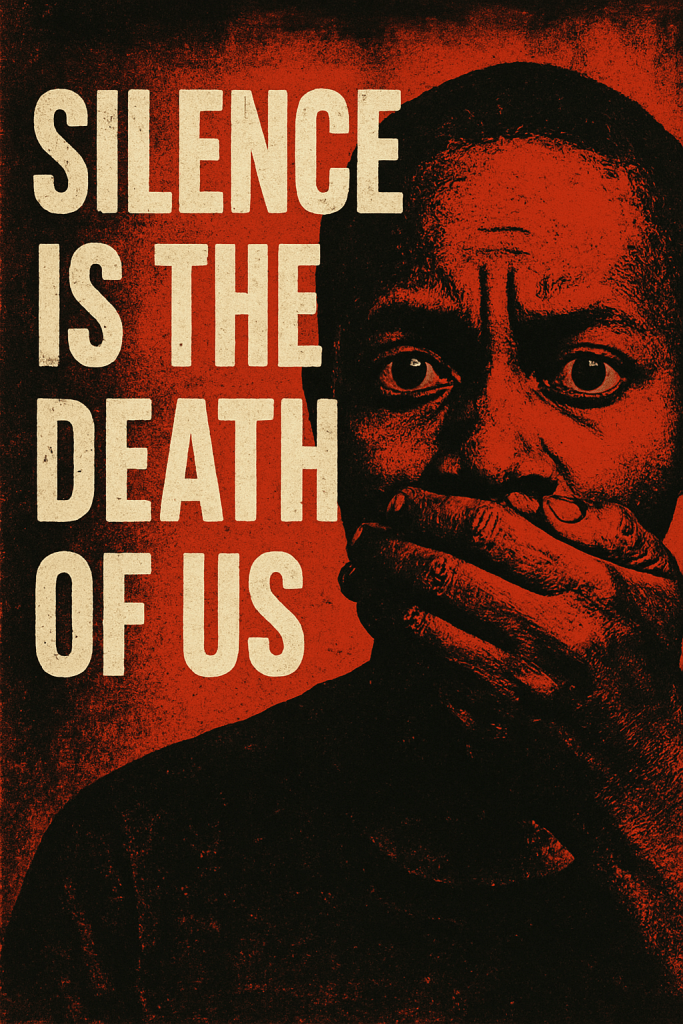
SILENCE IS THE DEATH OF US
Dear Corporate,
I know you like your linen white.
White as milk.
With no stains, no creases,
And no voices too loud or opinions too strong.
You want clean reputations,
Clean photos, clean silence.
You like me better
When I just show up, smile, hit targets,
Say “yes sir” to everything and go home.
You like me better
When I keep the fire in my belly out of your boardroom.
When I don’t question, when I don’t care too much.
But here’s what you forget,
I was me before I became your employee.
I had a voice before I had your email signature.
I had convictions before I had a clock-in code.
And I’m not about to trade all that in
For job security and polite applause.
I love justice.
The same way you love KPIs.
I care about this country,
The same way you care about brand image.
So when you see me at a protest,
Don’t flinch.
I’m not unstable.
I’m not rebellious.
I’m just awake.
When I call out corruption,
I’m not ruining your name,
I’m protecting it.
Because if systems rot,
Your success does too.
When I tweet in anger,
It’s not because I’m angry all the time.
It’s because I still believe that things can change.
That voices matter. That silence is too heavy to carry anymore.
I’m not asking for much.
Just this,
Don’t punish me for caring.
Don’t blacklist me for believing.
Don’t put me in a corner
Because I refuse to play blind.
I want to work.
I want to grow.
But I also want to live in a country where truth doesn’t cost you your job.
Let me speak.
Let me stand.
Let me protest, cry out, and still walk into your office on Monday morning with purpose.
Because fighting for what’s right
And showing up for work
Aren’t enemies.
They’re both signs I give a DAMN.
So no,
I’m not mad.
I’m not disloyal.
I’m just patriotic.
And I won’t whisper that.
Sincerely,
Still the right person for the job. Just louder.
@okelododdychitchats
Silenceisthedeathofus #Speak #PoeticJustice #Justice #Justice4AlbertOjwang #SpeakUp #Corruption #EndCorruption
When I fall in Love
When I fall in love,
there will be no trumpet,
no choir of angels rehearsing hallelujah,
just the quiet breaking of bread
between two hands that have known hunger.
I will not ask the sun to shine,
it will.
I will not beg the wind to be still
it will not.
But you,
you will laugh like sugar spilling from a jar
and I will remember
how joy can be messy
and still be beautiful.
When I fall in love,
I will not be the half of a whole,
I will be
the whole of a whole
meeting another
who does not need
completing,
only witnessing.
There will be no ticking clock,
no red thread prophecy,
no trembling knees
(unless from laughter).
I will not call it fate.
I will call it choice.
I will choose you.
And choose you again.
Even when your smile falters,
even when your breath
carries thunder.
I will not write sonnets.
I will write grocery lists
with your name at the bottom
underlined twice.
We will argue about soup.
And make up in whispers
like old songs
that only the two of us remember.
When I fall in love,
I will not promise forever.
But I will give you every now
I can carry.
I will plant soft yeses
in the soil of every day.
I will hold space
for your shadow
and your shine.
And when I say goodbye,
(if goodbye must come)
it will be with the ache
of one who has lived
and not regretted
a single soft, unspoken
I love you.
When I fall in love,
it will not be a fairy tale.
It will be
a revolution
of two
sacred, flawed,
magnificent
souls
saying,
yes, still.
And you,
you will not be worshipped.
You will be
seen.
And that, my love,
is holy enough.
@okelododdychitchats
Hash Grill
Jojo loves Christmas the way Nairobi loves traffic, deeply, obsessively, and without an ounce of shame. While most people are nursing hangovers on Boxing Day, Jojo’s already counting down, “Only 363 and a quarter days to CHRISTMAS.”
Her real name is Joyce Muturi, but don’t call her that. To Jojo, “Joyce” belongs to women who wear stockings with open shoes and say things like, “Young people these days.” Jojo stands just over four feet something, she’s a Gen Z soul with the wisdom of someone much older. And yes, she wears a size three shoe.
She’s the last born, and you can tell. That effortless, carefree energy of someone who never had to serve tea to guests or fight over the remote. People call her Jojo or sometimes Joy, depending on how close they are. Mostly, though, she’s known as sunshine draped in sarcasm.
It’s Jojo’s birthday. We’re meeting at Hash Grill, a little hideaway stitched into the soft hemline between Pangani and Muthaiga. If you blink too fast, you might miss it. If you smell meat, you’re probably there.
It’s just past 4PM, and I’m riding in an Uber Baridi. The sky is cloudy but hasn’t opened up yet, like it’s holding back to keep things calm.
We’re slowly passing KCA University when I spot Jojo and Spiky waiting by the roadside. I call them, and they tell me their cab is running late, but it’s no big deal. They’re just happy to be together.
Spiky isn’t her real name. It’s the name the world gave her and she wears it well. Her government name is Winfred Wangui Mwangi. But please, don’t call her Winfred. Just don’t. And definitely steer clear of Mwangi, that’s her dad’s name. And her younger brother’s too.
Kikuyu naming traditions are a beautiful constellation of meaning and memory, stitched with ancestry and whispers from generations past.
As a Luo, things are simpler. My children will carry Okelo with pride, stamped bold as their surname. Their first names will be chosen by nature or circumstance. Born at night? She’ll be Atieno. Born in the evening? He’ll be Odhiambo. We name like we’re telling stories of time, of place and of arrival.
Spiky is in a blue denim dress that hugs her like good karma. Her makeup is a masterpiece. Her perfume is Something Arabic and complicated, Mist-ika-tul-Mystique or something like that. She smells like a desert breeze married to soft rebellion. She’s in a pink cap, stolen from my wardrobe with no intention of return. On her feet is a pair of adidas samba. She looks amazing !
Jojo is in brown khaki pants, a dark green sweatshirt, and her well-worn pair of Converse, her outfit speaks in quiet confidence, like a soft song only the soul can hear. Effortlessly her. Spiky is holding up her phone, laughter bubbling between them as they record a video. Jojo ducks her head, smiling that quiet smile she wears when the lens turns her way, shy, but glowing all the same.
We find our way through the laughter and clinking cutlery like ink curling across parchment, slow and sure, until we land at a corner table with a view of the world, well, at least a sliver of it. Down below, there’s a bare apartment, save for a single Turkish rug stretched across the floor like it was laid there with purpose. A woman stands quietly at the door, wrapped in a flowing hijab. I can tell she’s Muslim, not just from the hijab, but from the calm, grounded stillness she carries. I’ve always found Muslim homes to be beautifully minimal—like the space itself is pausing to listen.
Earlier, a waitress called Faith had welcomed me. I saw her name on the badge. I’d asked for a dawa (Hot water infused with lemon and ginger, sweetened with a touch of honey) because my throat was acting up. She was warm, the way you wish all waiters were. Now another one, Lucy, comes by to take our order but she seems impatient. We ask for five minutes, and she walks off looking half-convinced. I see her whisper to another waitress, Josephine, who comes over with a much softer approach. She takes her time with us. Helps us through the menu.
We settle on a platter for four because we’re hungry and also because meat. We also order hot drinks. When the food comes, it doesn’t just come. It arrives with flair. One guy has a camera, two others carry the tray like it’s the crown jewels, and Josephine follows with cutlery and serviettes.
I swear my appetite tripled in that moment.
The food is an edible sermon. It reminds me that life, even on its worst days, can be made bearable with well-grilled nyama choma.
But not everything is delicious. There’s a table in front of us with nine girls. Nine. All from the same office, you can tell. They keep side-eyeing me like I’m their tea break agenda. I try not to notice but I do. They whisper, they giggle, they chew me with their glances. I feel like a paragraph in a WhatsApp group I didn’t consent to.
Still, we eat. We laugh. We exist loudly. Hash Grill is an experience. The waiters here don’t have M-Pesa lady attitude. They don’t look like you owe them child support. The rooftop is chilled. The air has attitude. The ambiance sings, “You deserve this.”
As we leave, I tell myself, I will come back. With friends. Or alone. Or maybe with Pie (Pie is Spiky), my sweetheart. But I will return. Because some places are not about the food, or the music, or even the people.
Some places are about how they make you feel seen.
@okelododdychitchats
Everything Here Smells of You
Everything here smells of you.
And it’s driving me insane in the sweetest, slowest way.
The caution seat still wears your scent ,
like it misses you too,
like it knows something passed through it that doesn’t come around often.
The fleece blanket is basically you in thread and warmth.
I cover myself with it and swear I can hear your laugh if I’m quiet enough.
Even my chest,
my own damn skin,
smells like you stayed.
Like you pressed yourself into me and said, “Don’t forget.”
And I won’t.
Not with lips like yours, warm, like you know the secret to sunrise.
I imagine a kiss and it doesn’t even feel imaginary,
it feels like a memory I’m about to make again.
I love the way your waist fits in my hands,
like my fingers were carved with your shape in mind.
There’s something wild about that kind of symmetry.
You’re beautiful.
You’re art that didn’t ask to be admired,
but was anyway,
because how could the world not notice you?
@okelododdychitchats
The Sound of Love (In Three Words)
There is a river in my chest,
its current stirred by longing.
I have wrestled with syllables,
wrestled them like Jacob with the angel,
and still, they slipped from me.
I’ve summoned sonnets like old friends,
dressed up my ache in velvet metaphors,
cradled my truth in gilded rhyme,
but still, the soul was unclothed.
Words, those proud and peacock things,
marched across parchment
but none bore the weight
of my trembling heart.
Then came silence.
And out of silence,
three humble drumbeats:
I. Love. You.
They stood,
not as grand orators,
but as gospel.
Simple.
Sacred.
Enough.
@okelododdychitchats
 okelododdychitchats