My Mother’s Son

I learned the way a man should stand and walk
From my mother, whose lowly, luminous hand
Guided the flame and kept the bitter draft out.
She taught me strength is not a frozen thing,
But something fluid, like a mountain brook
That yields to stones yet finds its own deep way.

So if I seem a trifle soft to you,
Or if my eyes should cloud and spill a tear,
Know that I’m built of different wood and sap.
I do not fit the narrow, leather shoes
The world has cobbled for a generic foot,
They pinch the heel and bruise the natural step
Of a man who’d rather walk a grassy path.

One may be pressed to edges, sharp and cold,
To please a neighbor’s sense of how things look,
But there’s a boundary where the self begins,
A stone wall built of choices, not of spite.
I’ll stay within the garden I have grown,
Where fruit is sweet and every branch can bend.
Let me be just as I was meant to be,
I have no need to wear a stranger’s coat.

@doddyokelo

The Performance

The plastic turns to liquid under the lighter.
It is the only thing that speaks clearly to me.
A hot, heavy drop,
a sting that binds me to this earth
when my mind wants to surrender to a sky with no sun.
They call it pain.
I call it a reminder that I am still here.

I am an actor who has forgotten the script,
so I improvise.
I borrow a smile from the person next to me.
I mirror their laughter until it sounds real enough
to pass the inspection of friends.
“I am fine,” I say,
because the truth is too heavy to carry in public.

I do not know what happiness is.
I have seen it on others,
like a coat that doesn’t fit my shoulders.
I tell the joke, I wait for the reaction,
and then I whisper that I am kidding.
But I am not.
I am just a person standing in a room,
waiting for the fire to tell me I am alive.

@doddyokelo

The Opportunity Cost of a Lost Girl: Why Adolescent Health Is an Economic Issue

To address the structural challenges of adolescent health in Kenya, experts are increasingly viewing the Triple Threat, the intersection of teenage pregnancy, HIV, and gender-based violence, as a singular public health emergency that requires a unified institutional response. The gradual erosion of national pregnancy rates, which dropped from 18% to 15%, is seen by policy analysts as a sign of progress, yet one that masks deep-seated regional inequalities. In areas like Samburu, where the rate remains at 50%, the crisis is viewed not merely as a health issue, but as a systemic breakdown of the protective social infrastructure intended to support the girl child. This crisis is compounded by the Triple Threat synergy,  a lack of agency to negotiate safe sex often results in a simultaneous surge in new HIV infections and unplanned pregnancies, frequently rooted in gender-based violence.

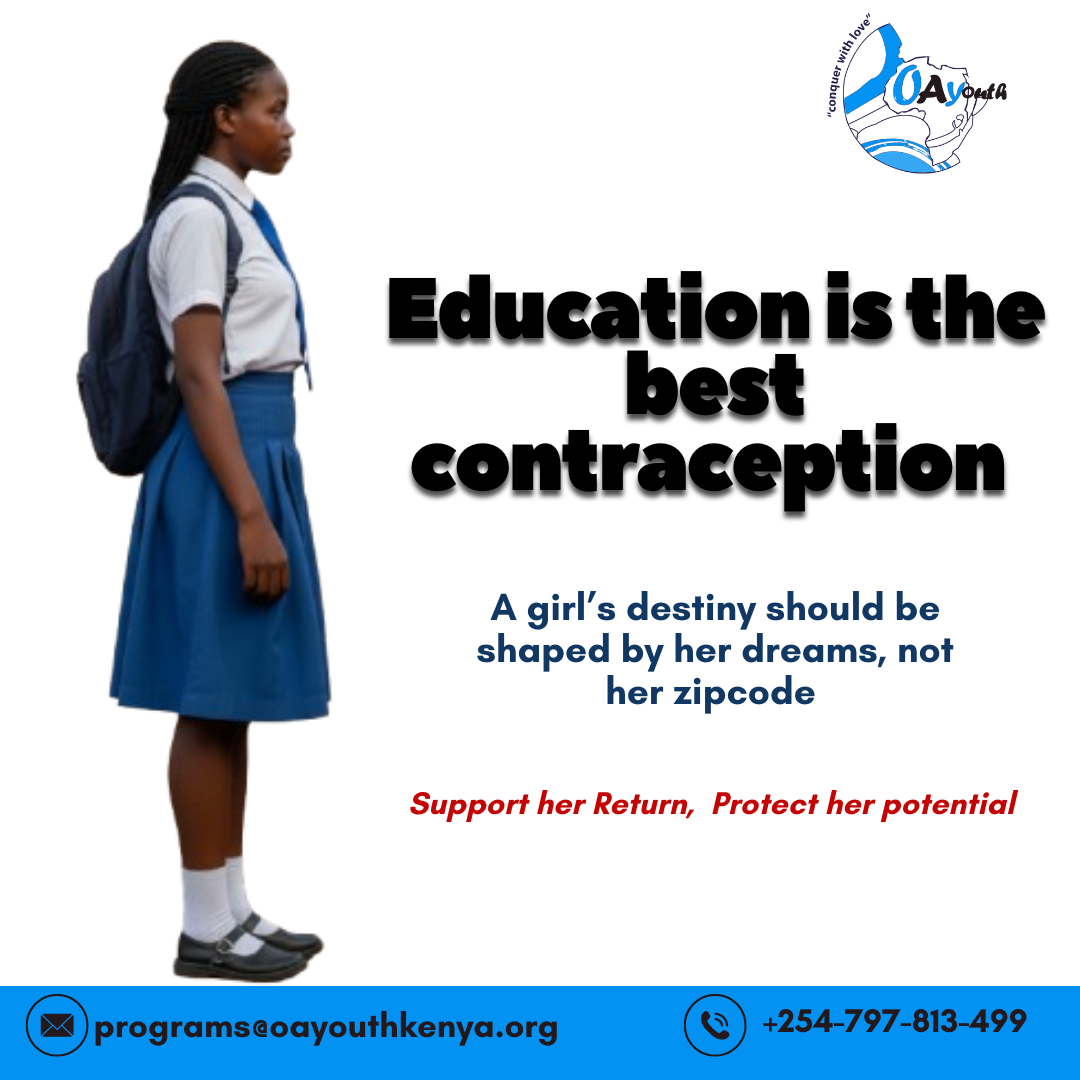
Education remains the most significant predictor of reproductive outcomes in the country. Data from the Kenya National Bureau of Statistics (KNBS, 2022) indicates that only 5% of girls who complete secondary school become pregnant, a stark contrast to the 40% observed among those with no formal education. Institutional experts emphasize that education is thebest contraceptive, serving as the most effective long-term shield for a girl’s future. The current Education Re-entry Policy is designed to treat pregnancy as a temporary pause in a girl’s development rather than a permanent exit from society. By mandating that schools readmit young mothers without conditions, the government is prioritizing the long-term economic viability of these young women. We must support her return and protect her potential to mitigate the massive opportunity cost to the national GDP.

With the rollout of the Social Health Authority (SHA), there is a strategic move to eliminate the financial barriers that often drive transactional sex. This phenomenon occurs when girls, particularly from the poorest households, exchange sexual favours for basic necessities like sanitary pads or school fees. Health administrators argue that removing the cost of maternal care is a pivotal step in normalizing adolescent health services. When girls can access youth-friendly clinics without the fear of financial strain or the stigma of judgment, the likelihood of safe deliveries and the adoption of postpartum family planning increases. This approach frames reproductive care as an essential public service, similar to the management of other chronic health conditions.

Sociological research highlights that the social death of a pregnant teenager is frequently a by-product of community-level shaming. While childbearing rates are significantly higher in the lowest income bracket, they drop drastically for the wealthiest, suggesting that pregnancy is often a symptom of economic desperation. The community’s role must shift from isolation to integration, especially as new threats like digital grooming emerge. Experts suggest that a girl’s destiny should be shaped by her dreams, not her zip code, and that ending thesocial death of teenage pregnancy is Kenya’s path to a stronger nation. Breaking the cycle of poverty requires community leaders to stop negotiating defilement cases through traditional settlements and instead move toward formal legal accountability.

For Kenya to reach its development goals, the focus must remain on the enforcement of the Sexual Offences Act at the grassroots level. Legal advocates insist that justice cannot be settled with livestock or secret payments. Every instance of legal accountability sends a clear signal that the safety and education of the girl child are non-negotiable national priorities. By aligning government policy, community action, and economic support, the goal is to ensure that every girl has the power to decide her own future on her own terms.

@doddyokelo

Simply Hope

The sky pulls a charcoal blanket over its shoulders,
heavy and weeping.
From a great height, the rain descends,
turning the world into a place of hiding,
a place where we fold ourselves small
behind locked doors,
wishing to vanish with the light.

But the atmosphere is restless.
A sudden fracture of silver splits the grey,
and the silence is startled
by the loud, golden arrival of the sun.

It isn’t just light,
it is a prism breaking across the horizon,
the earth looking up and finally smiling back.
The air feels new,
charged with that sudden, sharp pain of romance,
the kind that arrives when you realized
you survived the storm.

We learn then,
watching the shadows dissolve into nothing,
that darkness is a poor tenant.
It has no permanent address here.
The light is the only thing
that knows its way home.

@doddyokelo

A Simple Faith

It begins as a fracture in the monolith of night,
not a flood, but a thin, insistent silver
widening the door.

We call it belief,
but it functions more like a spine,
the invisible architecture that holds us upright
when the gravity of the world
tries to pull us into the dust.

To trust the Unseen is to plant a garden
in the middle of a drought,
knowing the rain is already traveling
toward you from a horizon you cannot yet see.

It is the alchemy of the soul,
turning a desperate plea into a rooted hallelujah,
folding the abyss of a thousand whys
into the quietude of a single yes.

When the world loses its voice to the thunder,
faith provides the dialect of peace.
It is the power to stand amidst the ruins
and speak of the rising song yet to be built.

@doddyokelo

Mama

The world is wide and filled with borrowed things,
With pale stars losing heart and roads that end,
But you are the original, the source,
The porch light in the dark I first learned to love.
I find you in the breath between the chimes,
The tether of your hand upon the spinning world,
Turning the tremor of the crowd to song,
And making sense of all I cannot say.

Your name, Aleq
sounds like water over stone,
An ancient music in the blood.
You taught me that a heart is not a cage,
But a wide window looking toward the sun,
You gave me wings so I could learn to fly,
And held the string so I would not get lost
Among the stars or in the trackless forests.

To love a mother is to know the truth,
That grace is not a gift we ever earn,
But a long shadow cast by someone’s soul.
I stand within that light and find my way,
Carrying your strength like a hidden coin,
Wealthy in the ways that truly matter.
You are the anchor in the shifting tide,
The only compass I will ever need.

@doddyokelo

The Harvest of Your Ghost

Dad,
Did you have to lay your hammer down so soon,
And quit the road while mine was barely paved?
I never learned the true note of your voice,
Nor how your laughter caught the light of day.
I ask the wind, but the wind won’t talk to me.

They tell me that we move across the earth the same,
A heavy shoulder, a loose and measured swing,
An inherited grace that only blood can take.
They say the gap between my teeth is yours,
And that my eye for color,
Was a dye cast deep in the well of my bones.
I take their word, I search for the traces of you in the mirror.

Three years old is barely time to learn a face,
Much less the weight of wisdom or of flaws.
I still build a life of what-ifs in the dark,
What stories would you have pressed into my palms?
Which of your fires would you have wanted me to keep?
And what soft, breaking things would you have spared me?
Would we have stood as one against the dark,
A  league against the world’s sharp edge?

This grief is a slow rust, it eats at the joints.
It settles in the wood time forgot to shape.
And god, it burns to know you stepped away
Just as the world began to hold its breath,
Before you taught me how to plant my feet
Or find the architecture of a man.

But here I am, I walk the line you drew,
Wearing half your face.
And I hope, as the seasons stack their weight,
You rest somewhere unburdened,
Knowing I am the harvest of your ghost.

@doddyokelo

A Peace I Cannot Take Yet

The world was a thief in a velvet cloak,
It took the bread, the wine, the light.
It turned to ash the words I spoke,
And left me shivering in the night.
I gave my gold, my grace, my years,
To hands that only learned to take,
Until the well of all my fears
Ran dry within an empty lake.

I do not fear the quiet dark,
The ending of the breath and bone,
I do not dread the final spark
That leaves the weary traveler prone.
The grave is but a silent bed,
A place where treachery must cease,
Where heavy hearts and aching heads
Are folded in a shroud of peace.

But oh, the faces at the door,
The ones who hold my tattered name.
I fear the shadow on their floor,
The snuffing of their candle flame.
For though the world has stripped me bare
And traded kindness for a stone,
Their love is all the breath and air
That I have ever truly known.

I stay for them. I bear the weight.
I walk the miles I cannot stand.
I bar the final, silent gate
With nothing but a trembling hand.
It isn’t death that makes me weep,
Or shadows where the spirits roam;
It’s knowing, if I fall to sleep,
I leave a broken house for home.

@doddyokelo

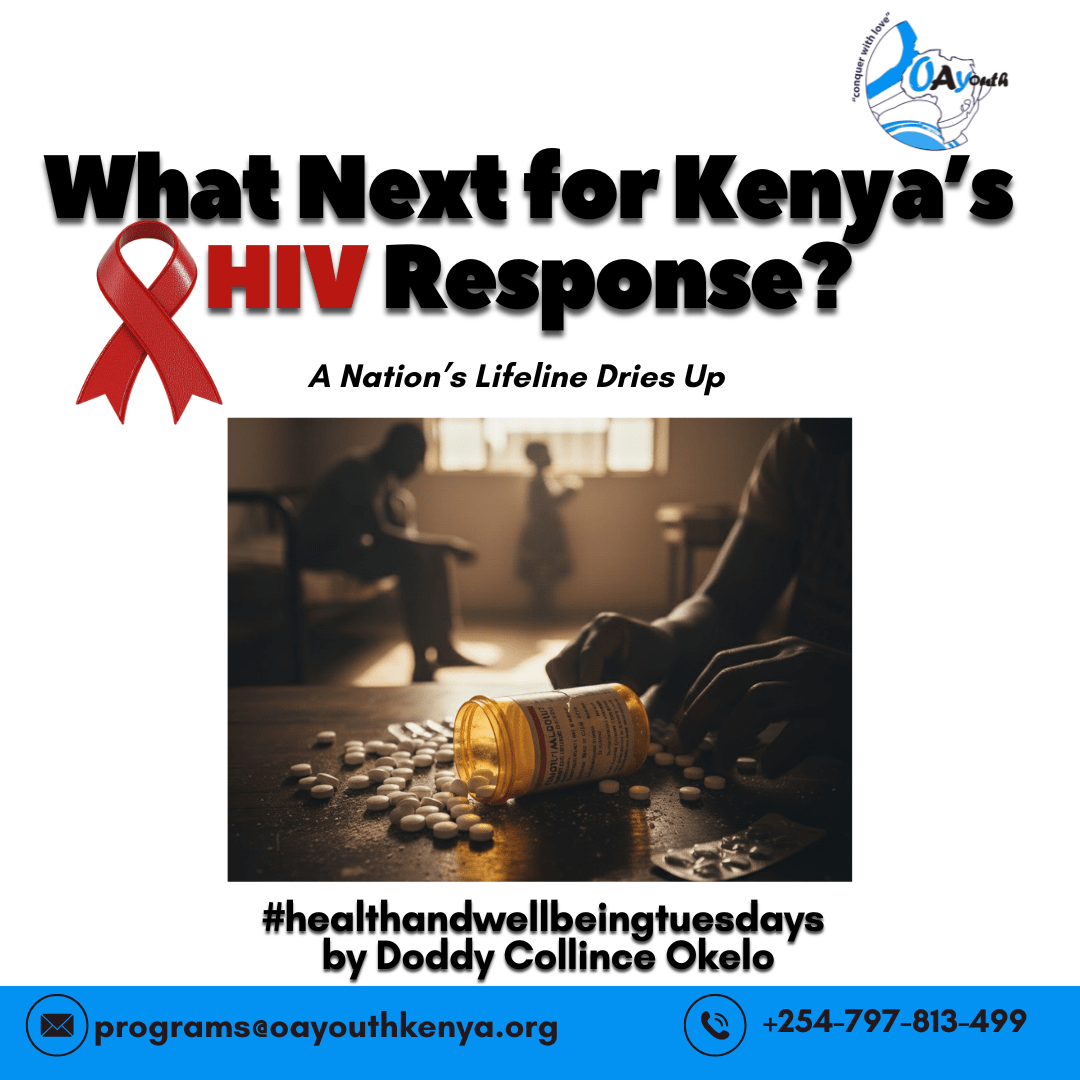
What Next for Kenya’s HIV Response?

Otieno, a resident of Kamwango in East Kamagambo, Rongo Sub-county, sits on the edge of his bed, the weight of the world pressing heavily upon his shoulders. He looks at his wife, Achieng, who is meticulously organizing their remaining ARV tablets, and their seven-year-old daughter playing by the window. For years, those pills have been their lifeline, a daily ritual of survival. But the news on the radio is cold. Following the transition in Washington on January 20th, 2025, and the looming impact of March 2026, the whispers in the clinic queues have turned into a dull roar of panic. He hears that the containers might stop coming, and the thought of the virus waking up in his daughter’s blood because of a political shift thousands of miles away is a terror no father should carry.

For 23 years, Kenya has been receiving roughly 69% of its HIV funding from the United States Agency for International Development (USAID) and the United States President’s Emergency Plan for AIDS Relief (PEPFAR). This massive investment, totaling over 8 billion dollars (approximately 1.1 trillion Kenyan shillings) was the backbone of the national response, paying for the very ARVs Otieno’s family is counting on, the laboratory reagents for viral load testing, and the salaries of over 40,000 health workers, nearly 18% of the country’s total health workforce, who now face an uncertain future.

The crisis has ceased to be a storm on the horizon, it has become the drying of the well, a sudden, natural silence where the ever-flowing vein of supply once lived long. Since the executive freeze in early 2025, approximately 34 million dollars (4.5 billion Kenyan shillings) worth of life-saving commodities have been caught in a logistical gridlock. This disruption was triggered by a stop-work order that deactivated the payment and distribution systems managed by U.S.-funded agencies. By March 2026, the buffer stocks that once protected patients like Otieno from supply shocks will have run dry. In many facilities, doctors have been forced to ration medicine, moving from three-month prescriptions to one-week emergency packs, a desperate measure to ensure that at least everyone gets something, even if it isn’t enough.

To bridge this gap and heal the mess of daily adherence, there is a growing call to develop and deploy long-acting treatments for reactive individuals. While currently available injections like Cabenuva require a visit every two months, the dream is to innovate even further, creating a once or twice yearly injection specifically for treatment. Such a breakthrough would be the ultimate sustainability tool by replacing 365 daily reminders with just one or two clinical visits, the government could drastically reduce the logistical nightmare of monthly pill distribution. It would solve the adherence crisis for families like Otieno’s, ensuring that even if a shipment is delayed or a clinic is crowded, their protection remains locked in their blood for months. This transition to long-acting treatment is the missing piece that could turn the tide, making the 2030 goal of zero transmission a reality by removing human error and pill fatigue from the equation.

The physical landscape of care is also shrinking. Community Drop-In Centers, which provided a refuge for vulnerable groups to receive medication away from the prying eyes of the general public, have begun to shut their doors as their rent and staff costs were tied directly to the now-paused U.S. grants. This has pushed thousands of patients back into overcrowded outpatient clinics where stigma remains a biting reality. The shift is driven by a fundamental pivot in U.S. foreign policy toward domestic rescissions, clawing back billions in global health aid and leaving a Sh30 billion hole in Kenya’s 2026 health budget.

The Kenyan government has responded with urgency and strategic redesign. Health officials, led by the Ministry of Health, are frantically working to integrate HIV services into the new Social Health Authority (SHA). The goal is to move HIV care from a donor-funded silo into the national insurance framework, essentially treating it like any other chronic condition. To prevent a total stockout, the government is also fast-tracking licenses for local pharmaceutical companies to manufacture ARVs within Kenya, aiming to break the cycle of dependency on foreign shipments that can be halted by a single signature in a foreign capital.

Sustainability is the ultimate goal, but it is a bridge built under fire. The National Treasury is being asked to ring-fence emergency funds to unlock meds held in private warehouses, while civil society groups under the National Empowerment Network of People living with HIV in Kenya (NEPHAK) have taken to the streets to demand that laboratory tests, like viral loads and CD4 counts, remain free under the new insurance scheme. While the move toward a Kenyan-led, self-reliant system is the only long-term solution, for Otieno’s family, the immediate reality is a month-by-month struggle to stay undetectable while the country waits for the first gears of its own factories to turn with purpose.

@doddyokelo

Just the Two of Us

I want to wake while the world is still gray
and see the sun start its fire in your eyes,
to watch the morning climb your throat
and spill across the bed like spilled honey,
sticky and warm and ours.
I want to witness the exact moment
the light claims you,
making a map of every curve I know by heart.

But the day is just the waiting room for the dark.
I want the hours when the house grows quiet,
when we peel back the noise of the street
and the heavy expectations of being men and women.
I want to slide into the night with you,
rib to rib, a slow collision of heat
until my pulse finds the measured thrum of yours
and stays there.

I want the salt of your skin against my tongue,
the scent of woodsmoke and wild things
clinging to the places where we touch.
I want to be so tangled in your limbs
that the blankets feel like a burden,
nothing between us but the fever
of two people trying to beat back the cold.

Let the world break itself outside the door.
In here, there is only the press of your weight,
the velvet friction of breath on breath,
and the long, slow sinking into sleep
where my skin forgets itself
and simply becomes a part of yours.

@doddyokelo